

Fibrosis and Tissue Remodeling
and Tissue Fibrosis Mechanics


Overview of Fibrosis and Tissue Remodeling Mechanics
Fibrosis is characterized by excessive extracellular matrix deposition, altered collagen organization, and increased tissue stiffness. These mechanical changes actively regulate cellular behaviour through mechanotransduction pathways, reinforcing disease progression across multiple organ systems including lung, heart, liver, vasculature, and skin.
- Mechanical testing supports research in:
Across published tissue fibrosis studies, mechanical testing is used to quantify stiffness gradients, characterize viscoelastic behaviour, and track mechanical evolution during disease progression or therapeutic intervention. Quantitative mechanics provide essential metrics for comparing healthy, diseased, and treated tissues.

Importance of Mechanical Testing in Fibrosis Research
Tissue remodeling occurs in both pathological and regenerative contexts, involving dynamic changes in stiffness, anisotropy, and time-dependent behaviour as cells deposit, reorganize, or degrade matrix components. Mechanical feedback between cells and matrix plays a central role in driving fibroblast activation, myofibroblast differentiation, and persistent matrix stiffening.
Mechanical testing enables researchers to:
- Quantify stiffness changes that drive mechanotransduction signaling
- Distinguish mechanical differences between healthy and fibrotic tissues
- Evaluate progression or reversal of fibrosis during treatment
- Assess heterogeneity within remodeled tissues
- Compare in vitro fibrosis models to in vivo mechanics
- Study feedback between matrix stiffness and cellular activation
- Generate inputs for computational and multiscale disease models
Accurate mechanical characterization strengthens mechanistic understanding of fibrosis and improves evaluation of therapeutic strategies.
Recommended CellScale Instruments for Tissue Remodeling & Tissue Fibrosis Mechanics

MicroTester
Ideal for low-force indentation and micro-compression testing to map localized stiffness changes in fibrotic tissues and in vitro remodeling models.

UniVert
Used for uniaxial tensile and compression testing of fibrotic tissue samples and remodeled constructs across a wide stiffness range.
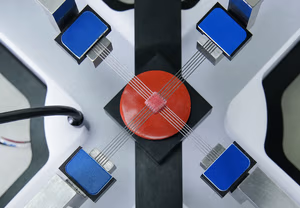
BioTester
Supports biaxial testing of planar tissues where fibrosis alters anisotropy and in-plane mechanical behaviour.

MechanoCulture TR
Applies controlled hydrostatic pressure to in vitro fibrosis models to study mechanotransduction and stiffness-driven remodeling.
Testing Methods for Fibrosis and Tissue Remodeling
Compression Testing
Quantifies stiffness changes in fibrotic tissues
Shear Testing
Evaluates shear strength, interfacial mechanics and adhesion behaviour in soft tissues
Pressure Testing
Quantifies stiffness changes and nonlinear remodeling effects in pressurized tissues
Hydrostatic Pressure Testing
Evaluates pressure-driven deformation in fibrotic organs and tissues
Hydrated & Temperature-Controlled Testing
Preserves physiologic conditions critical for fibrosis mechanics
Representative Sample Types in Tissue Fibrosis Mechanics Research
Native fibrotic tissues
- Fibrotic lung, cardiac, and vascular tissues
- Skin and connective tissue fibrosis samples
In vitro fibrosis and remodeling models
- Cell-laden hydrogels with induced stiffening
- Mechanically conditioned fibrosis models
- Engineered tissues with progressive matrix deposition
ECM and matrix-focused systems
- Decellularized matrices undergoing recellularization
- Collagen-rich fibrotic scaffolds
- Crosslinked or remodeled ECM constructs
Therapeutic and intervention models
- Antifibrotic drug-treated tissues
- Stiffness-modulated disease models
- Remodeling reversal and recovery systems
Recent Publications in Fibrosis and Tissue Remodeling

Advance Your Fibrosis and Tissue Remodeling Research
CellScale systems support tissue fibrosis mechanics, tissue remodeling studies, and mechanobiology research requiring precise force control and physiologic testing environments. Contact our team to identify the optimal testing platform for your fibrosis mechanics workflow.
