

Cardiac Tissue Engineering
and Cardiac Biomechanics

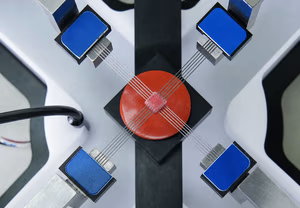
Overview of Cardiac Tissue Engineering and Cardiac Biomechanics
Cardiac tissue engineering focuses on the creation of functional heart tissues that replicate the structure, mechanics and electrophysiology of native myocardium. Researchers study cardiomyocytes, fibroblasts, engineered scaffolds and multicellular constructs to understand how mechanical loading shapes cardiac development, disease, and repair. Mechanical behaviour, including stiffness, viscoelasticity, contractile force, and nonlinear strain response, is essential for predicting functional maturation and therapeutic potential.
- Key mechanical considerations in cardiac biomechanics:
The field investigates how engineered tissues form, integrate and remodel under mechanical conditions that approximate the cardiac cycle. Properties such as modulus, contractility, stress relaxation and fatigue resistance influence electrical conduction, sarcomere assembly, and the progression of fibrosis. Testing also supports applications in disease modeling, drug screening, regenerative systems, and the development of implantable cardiac patches.

Importance of Mechanical Testing in Cardiac Tissue Engineering
Mechanical forces regulate many aspects of cardiac physiology. Engineered heart tissues experience dynamic loading that influences maturation and alignment, and mechanical stimulation is often necessary for functional contractile behaviour.
Testing provides quantitative data that:
- Links tissue stiffness to cardiomyocyte organization and calcium handling
- Evaluates how engineered tissues respond to cyclic strain that mimics the cardiac cycle
- Identifies remodeling pathways involved in fibrosis, hypertrophy or ECM turnover
- Assesses contractile strength for drug testing or disease modeling
- Supports computational model development for cardiac growth and adaptation
Mechanical properties help determine whether a construct will integrate safely with native myocardium or withstand implantation environments.
Recommended CellScale Instruments for Cardiac Tissue Engineering Research

BioTester
Ideal for biaxial testing of pericardium, valve leaflets and planar cardiac tissues where anisotropy and regional behaviour are important.

UniVert
Provides uniaxial tensile and compression testing for cardiac scaffolds, patches and biomaterials across a wide range of stiffnesses.

MicroTester
Used for micro scale mechanical testing of cell laden hydrogels, engineered scaffolds and cardiac microtissues, including measurements of contraction and small-scale stiffness.

MechanoCulture T6
Used for controlled cyclic stretch experiments that replicate physiologic strain patterns and enable mechanobiology studies of cardiomyocytes and engineered heart tissues.
Testing Methods Commonly Used in Cardiac Tissue Engineering
Tensile Testing
Evaluates strength and stiffness of cardiac scaffolds and patches
Compression Testing
Assesses bulk modulus and tissue resistance
Stress Relaxation Testing
In soft, hydrated biological materials
Digital Image Correlation
Enables full field strain mapping during mechanical loading
Pressure Testing
Reproduces physiologic pressurization of cardiovascular tissues and implants
Representative Sample Types in Cardiac Biomechanics
Native cardiac tissues
- Myocardium
- Pericardium
- Valve leaflets
Engineered materials
- Cardiac scaffolds
- Printed or molded hydrogel constructs
- Fibre reinforced matrices
Microscale constructs
- Cardiac microtissues
- Spheroids for drug testing
- Stem cell derived cardiomyocyte aggregates
Disease models
- Fibrosis models
- Hypertrophic cardiomyopathy constructs
- Inflammatory remodeling systems
Selected Publications in Cardiac Tissue Engineering

Advance Your Work in Cardiac Tissue Engineering
If you are planning mechanical testing for engineered heart tissues or cardiac biomaterials, our technical team can help you select the most suitable platform.
