

MicroSquisher
Legacy Product

The MicroSquisher is a legacy micro-scale testing platform that still appears in peer-reviewed biomaterials and mechanobiology studies. While it has been succeeded by the MicroTester, many MicroSquisher legacy product units are still running in active labs. CellScale provides support for legacy instruments to help groups keep existing workflows consistent, especially when studies span multiple years or cohorts.
For new projects or expanded capability, the upgrade path to MicroTester is the recommended current platform for comparable micro-scale mechanical testing. This page is here for researchers who find the MicroSquisher in the literature and want practical notes for continued use, service decisions, and translating protocols from legacy mechanical testing systems to the current lineup.

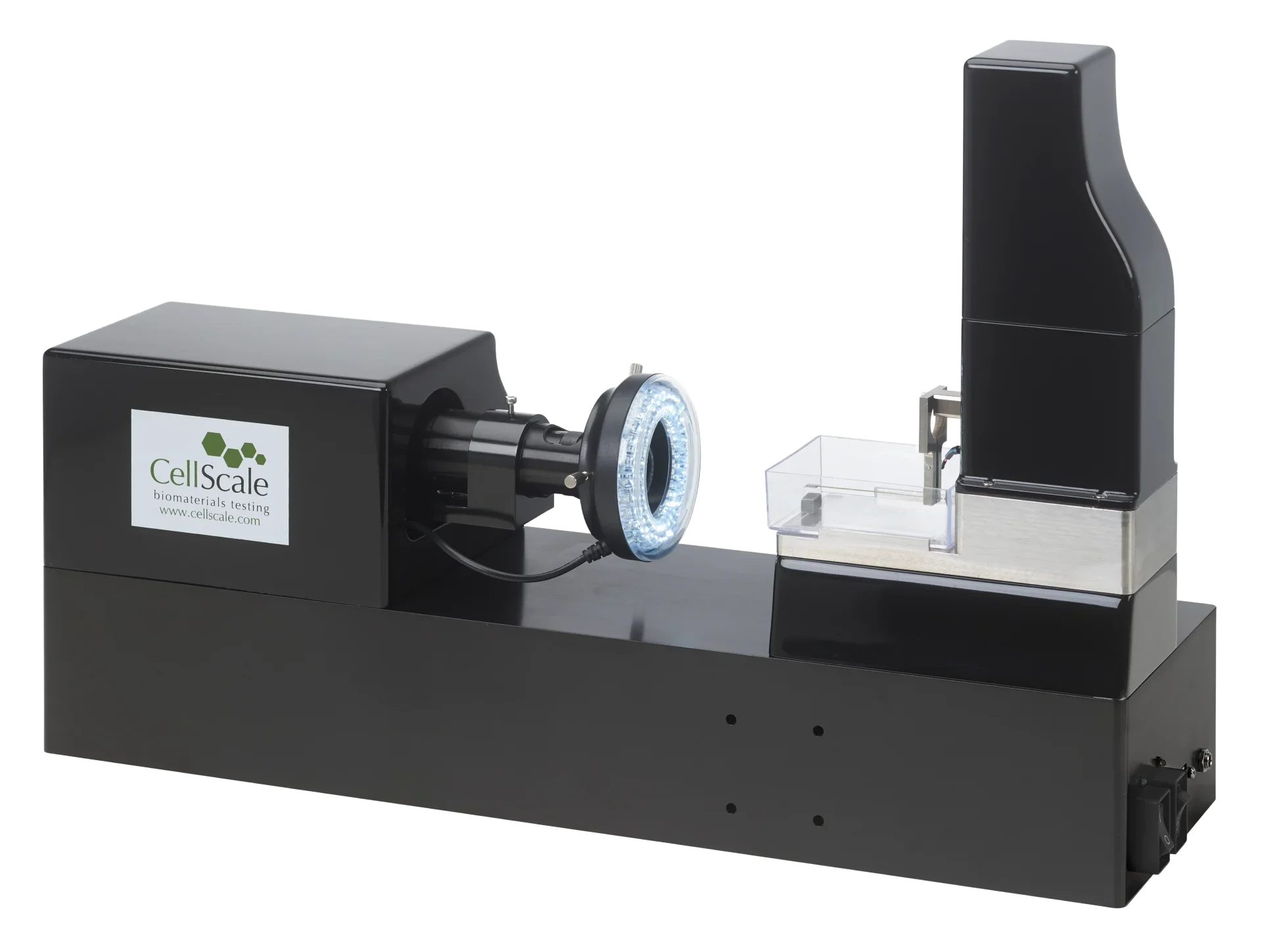
MicroSquisher Overview
The MicroSquisher was developed for mechanical testing of small, compliant specimens where conventional materials frames can be limited by handling, alignment, and force resolution. Typical tests load a hydrated specimen between platens and apply deformation using displacement control or force control. Force is determined from microbeam deflection paired with image-based tracking of the microbeam tip.
In the literature, the MicroSquisher is most often used for micro-compression tests on small biological or biomaterial samples. Many papers also show simple hold steps, where the deformation is applied and then held to watch the load change over time (for example, creep-style and relaxation-style runs). If you are pulling a MicroSquisher method from a publication, the same test logic can be carried over through the MicroTester, while keeping specimen preparation and reporting conventions consistent.
Legacy Mechanical Testing Systems
The MicroSquisher is part of a broader set of legacy mechanical testing systems that remain in circulation because they were widely adopted in early and mid-stage biomaterials research. Many labs continue to rely on these systems for longitudinal studies, comparison to historical datasets, or direct replication of published protocols.
Researchers typically arrive on this page with one of three needs:
- Confirm what the MicroSquisher legacy product is and how it was used in publications
- Determine options for support for legacy instruments in an active lab setup
- Identify a practical upgrade path to MicroTester for new programs or replacement planning
Support for the MicroSquisher
If your lab is still running a MicroSquisher system, support for legacy instruments usually focuses on replacement parts, software help, repeatability, signal quality, and defensible data export for publications and internal comparisons.
- Common support topics include
Legacy MicroSquisher support depends on the specific configuration. Share your system details and the issue you are seeing for next-step guidance.
Research Applications Supported by the MicroSquisher
The MicroSquisher appears in publications that require mechanical readouts from delicate, small-volume specimens. The sections below reflect common patterns seen in MicroSquisher studies and are useful when mapping methods to current platforms.
Microtissue and Spheroid Mechanics
Mechanotransduction Studies
Hydrogel Mechanical Testing
Organoid and Tissue Mimetic Systems
Injectable & Regenerative Biomaterials

Testing Methods Associated with the MicroSquisher Legacy Product
Across the literature, the MicroSquisher is most often tied to a core set of methods that are well matched to small, hydrated specimens:
Compression Testing
For micro-scale tissues and biomaterials
Viscoelastic and Time-Dependent Testing
Using step-and-hold sequences
Stress Relaxation Testing
Using displacement steps with sustained holds
Creep Testing
Using force holds to quantify time-dependent deformation
Hydrated & Temperature-Controlled Testing
To maintain physiologic-like conditions
Ultra-Low Force Testing
When subtle mechanical differences are important
Upgrade Path to MicroTester for MicroSquisher Users

An upgrade path to MicroTester is available for researchers and MicroSquisher users. If your lab needs hardware support, expanded configuration options, or improved imaging and analysis tooling, the MicroTester is your solution.
A clean upgrade plan starts with the protocol requirements.
- The most useful details are
With that information, the MicroTester can be configured to support the same experimental intent as the MicroSquisher.
FAQs About the MicroSquisher
Is the MicroSquisher legacy product discontinued?
Sort of. The MicroSquisher legacy product is no longer in production, but the system has been replaced and upgraded to the MicroTester.
What replaced the MicroSquisher legacy product?
For comparable micro-scale mechanical testing workflows, the current CellScale platform is the MicroTester which has the same capabilities and more.
Can I reproduce MicroSquisher methods on the MicroTester?
Yes. The MicroTester has the same capabilities and more.
What sample types were commonly tested with the MicroSquisher?
Typical samples: spheroids, microtissues, hydrogels, cell-laden constructs, and other small, hydrated specimens.
Does the MicroSquisher support hydrated testing and temperature control?
Yes, many MicroSquisher workflows are performed in a fluid bath to keep specimens hydrated, with temperature control used when experiments require stable conditions near physiologic temperature.
Can the MicroSquisher be used for stress relaxation and creep testing?
Yes. These appear frequently in MicroSquisher publications, typically using displacement holds for relaxation and force holds for creep, depending on the protocol.
Do you provide support for legacy instruments like the MicroSquisher?
We provide support for legacy instruments including the MicroSquisher in many active labs. Service feasibility depends on configuration and system condition.
Get MicroSquisher Support or Plan a MicroTester Replacement
If you are maintaining an active MicroSquisher system, need help matching a published method, or want a clear upgrade path to MicroTester, contact CellScale and share your specimen type and protocol goals. We can recommend the most direct route to maintain continuity in your mechanical data and reporting.
