Would a polymer made from longer molecular chains be more flexible? In a recently published study of four photo-cross-linked PTMC films, the 10 kg/mol formulation had the highest biaxial Young’s modulus and the lowest anisotropy index.
But the answer isn’t quite that simple. Networks made from both shorter and longer molecular chains can be less stiff.
In the study, researchers used poly(trimethylene carbonate), or PTMC, a biodegradable elastomer being investigated for biomedical applications. Their team included researchers at Université Paris-Est Créteil (this group are prominent CellScale system users!).
They prepared PTMC networks with different starting molecular weights. They measured the materials using biaxial tensile testing on a CellScale BioTester, then examined their molecular structure using solid-state NMR and their thermomechanical behaviour using dynamic mechanical analysis (DMA).
Why Use Biaxial Tensile Testing to Study Polymer Networks?
PTMC has many characteristics that make it valuable for biomedical materials research – it’s biodegradable, flexible, and can be photo-cross-linked into elastomeric networks. Researchers have explored its use in meniscus implants and microvascular structures.
But for these applications, the mechanical properties of the material are part of the design problem. A polymer network that stretches readily under one loading condition may respond differently when pulled in two directions at once.
PTMC has been studied extensively using uniaxial tension, compression, and other characterization methods. But much less has been reported about its response to multiaxial loading (like biaxial tensile testing).
Feyne and colleagues used simultaneous loading along two axes to address a specific question in polymer and elastomer mechanical testing: how does changing macromer molecular weight affect the response of a flat PTMC film?
They prepared four photo-cross-linked formulations using macromers with molecular weights of 3, 10, 17, and 25 kg/mol. The formulations were then subjected to biaxial tensile testing to see how their mechanical response changed with network structure.
The researchers were interested in stiffness, differences between loading directions, and the energy lost during repeated deformation.
How Was Equibiaxial Tensile Testing Performed on the PTMC Networks?
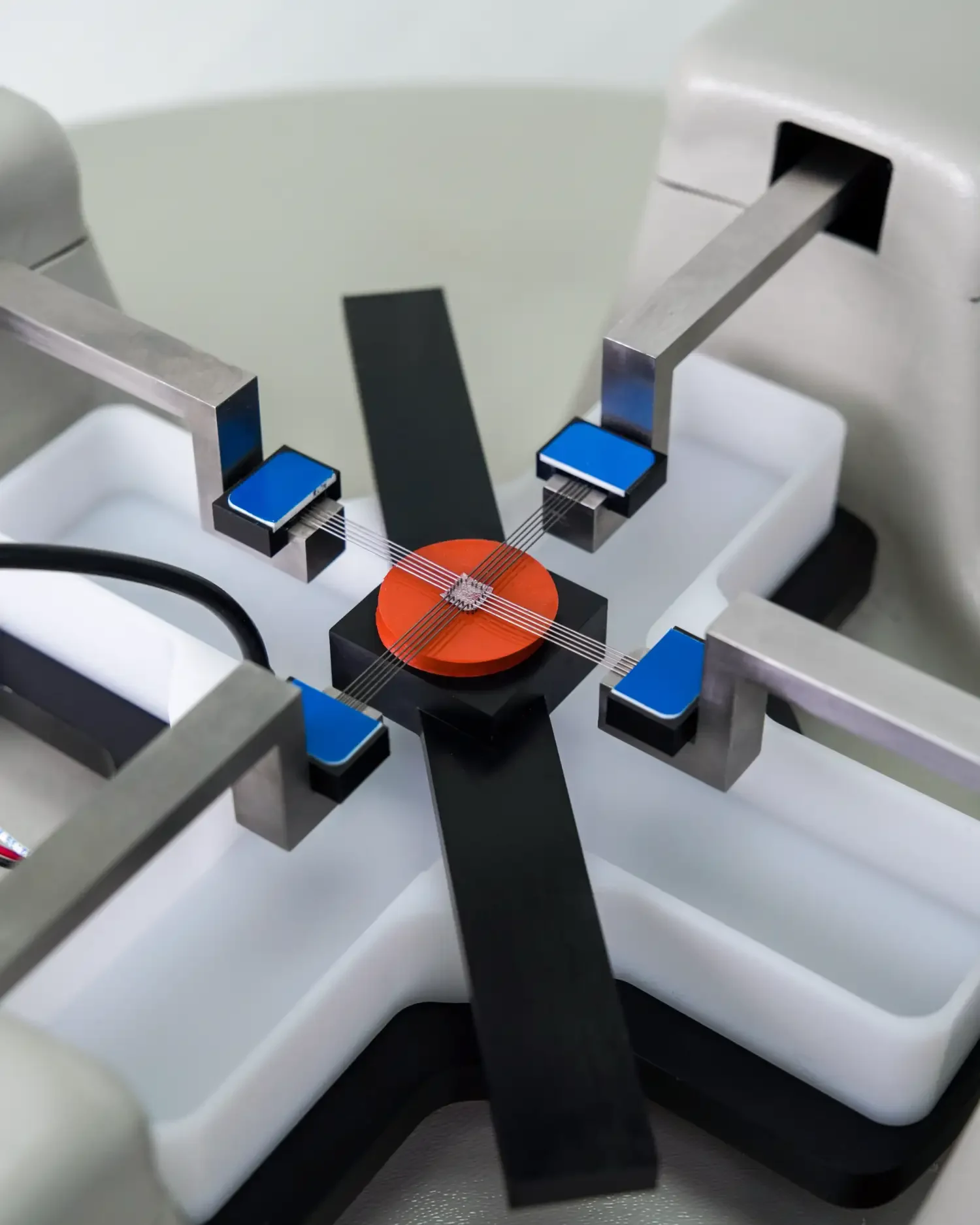
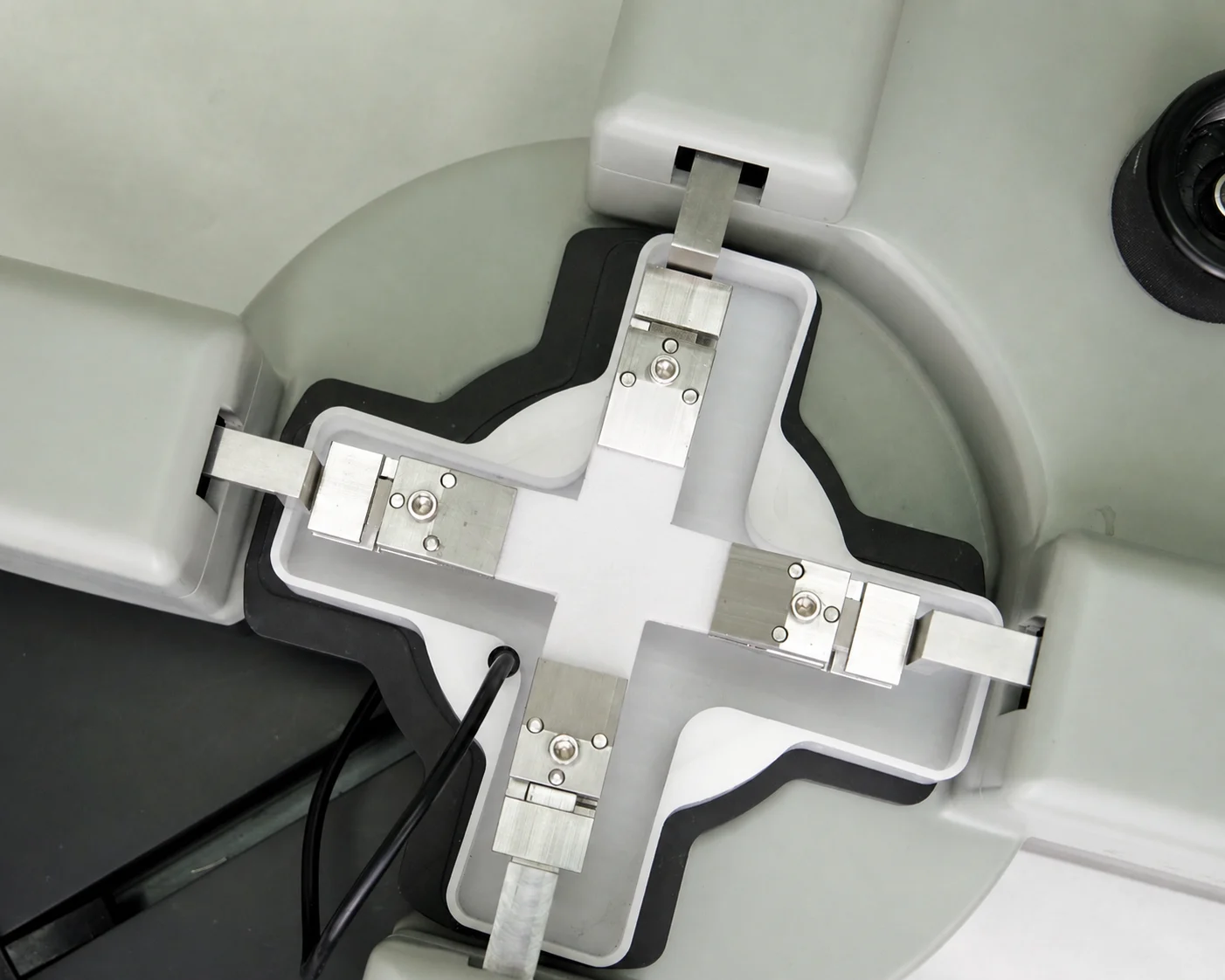
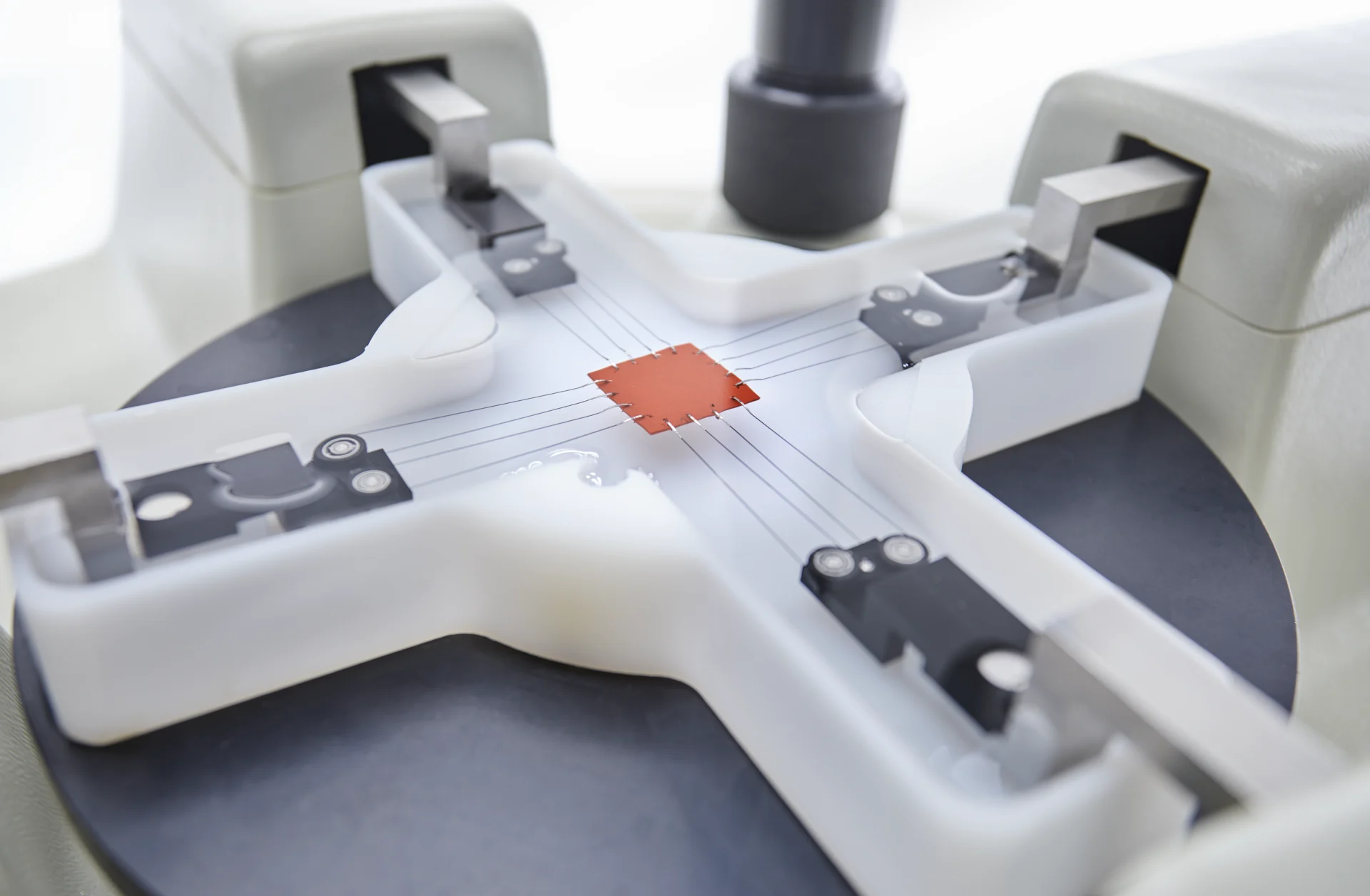
Each PTMC formulation was prepared as a cross-linked film. The researchers cut cross-shaped specimens measuring 3 cm × 3 cm and mounted them using mechanical grips along two perpendicular axes.
Specimen geometry and mounting are part of the mechanical characterization of polymer films and thin membranes.
The tests were performed on a BioTester fitted with 5 N load cells.
Before collecting the main measurements, each specimen underwent two preconditioning cycles to 2% strain. The researchers then applied equibiaxial tension at a strain rate of 1%/s, repeating the loading cycle five times.
From the recorded responses, they determined the elastic modulus using the initial part of the stress-strain curve. For the anisotropy index, they divided the absolute difference between the two directional moduli by their sum and reported it as a percentage. The analysis assumed a Poisson’s ratio of 0.33 for all specimens. The team also examined the hysteresis between loading and unloading.
What Did Biaxial Tensile Testing Reveal About Polymer Stiffness?
The network prepared from 10 kg/mol macromers had a biaxial Young’s modulus of 6.08 ± 0.13 MPa. The other three moduli fell between 3.53 and 3.93 MPa.
| PTMC macromer molecular weight | Biaxial Young's modulus |
|---|---|
| 3 kg/mol | 3.88 ± 0.09 MPa |
| 10 kg/mol | 6.08 ± 0.13 MPa |
| 17 kg/mol | 3.53 ± 0.10 MPa |
| 25 kg/mol | 3.93 ± 0.10 MPa |
The result was not a steady increase or decrease with molecular weight. Moving from 3 to 10 kg/mol increased the measured modulus, but the 17 and 25 kg/mol networks were both less stiff.
The figure below shows these differences in equibiaxial stress-strain curves. The blue curve, representing the 10 kg/mol network, rises more steeply than the other three. The 3, 17, and 25 kg/mol formulations follow more similar responses.

What About Mechanical Anisotropy and Hysteresis?
The researchers also calculated how much the measured modulus differed between the two perpendicular directions. The 10 kg/mol network had an anisotropy index of just 1.5%, compared with 14.6% for the 3 kg/mol formulation and 12.7% for the 17 kg/mol formulation. The 25 kg/mol sample fell between these groups at 4.6%.
In other words, the stiffest network also had the smallest directional difference in modulus.
The loading and unloading curves form loops. The area of each loop represents the mechanical energy dissipated in that cycle.
The reported dissipation ratios ranged from 0.08 to 0.22. The first cycle generally showed more dissipation, with lower losses during subsequent cycles. The authors suggested that the initial loading may have reorganized parts of the network before its response became more stable.
Hysteresis is one of the behaviours examined in viscoelastic testing, although this experiment was limited to five biaxial loading cycles. It was not designed to determine fatigue life or long-term durability.
Why Did the 10 kg/mol PTMC Network Behave Differently?
The researchers first compared the biaxial results with DMA, measuring how a material responds to small oscillatory deformation.
You can see the results for all four PTMC networks in the next figure. The storage modulus generally decreased with increasing macromer molecular weight in the rigid and elastic temperature regimes. The tan δ curves also differed in peak position and width, reflecting differences in thermal transition behaviour.

At 23°C, the DMA storage moduli were broadly comparable in magnitude to the Young’s moduli obtained from the biaxial tensile testing, but the formulations did not follow the same ranking.
At 23 °C, the 3 kg/mol formulation led the DMA results at 6.27 MPa. The 10 kg/mol formulation measured 4.73 MPa by DMA and led the biaxial tests at 6.08 MPa.
The small oscillations in DMA probed the films in the linear viscoelastic regime. The biaxial tests stretched the films in two directions at once.
To investigate the internal network structure more directly, the researchers turned to solid-state proton NMR.
How Does Cross-Link Density Relate to Biaxial Mechanical Properties?
Double-quantum ¹H NMR measurements provided information about molecular constraints within the PTMC networks. The researchers used these measurements to examine differences in cross-link density and the distributions of those constraints.

The 10 kg/mol formulation had a narrow distribution. Several of the other networks showed broader distributions, indicating greater variation in their molecular constraints.
The authors thought that the more uniform cross-link distribution of the 10 kg/mol network could contribute to its higher biaxial stiffness (they didn’t isolate cross-link uniformity as the cause).
They also compared the NMR measurements with cross-link density values estimated from DMA. The following figure plots residual dipolar coupling against the DMA-derived estimates:

The measurements were related, but not linearly. The authors discussed physical entanglements and network connectivity as possible reasons why cross-link density alone did not fully describe the mechanical response.
Their interpretation also helps explain why molecular weight by itself was a poor predictor of which PTMC network would be stiffest.
The BioTester's Role in the PTMC Study
The BioTester was used for biaxial tensile testing of the films, recording the response along both axes during repeated stretch and release.
The researchers applied repeated equibiaxial tension to cross-shaped specimens held in mechanical grips.
The resulting stress-strain measurements were used to determine modulus, compare the two loading directions, and quantify energy dissipation during loading and unloading.
These film-scale measurements gave the authors a basis for comparison with the DMA and NMR results.
What Can Researchers Take from These Results?
The stiffest material in this study didn’t depend on polymer chain length. It was the 10 kg/mol formulation, which also showed the lowest measured anisotropy.
The DMA and NMR experiments offered possible explanations for that behaviour, particularly differences in network heterogeneity and molecular constraints. They also showed that the relationship between polymer chemistry and mechanical properties can’t be captured by a single measurement.
A limit that’s worth mentioning: the researchers examined PTMC formulations under defined laboratory conditions. They did not investigate cell growth, implant performance, or tissue regeneration in this work (which may be something they do in the future).
For researchers developing biodegradable elastomers, the practical lesson is in the testing approach. Biaxial measurements can reveal differences in material response that are worth examining alongside molecular and thermomechanical characterization.
A related example of how polymer design influences mechanical behaviour can be found in our post on shape-memory polymer mechanical testing.
About the CellScale BioTester
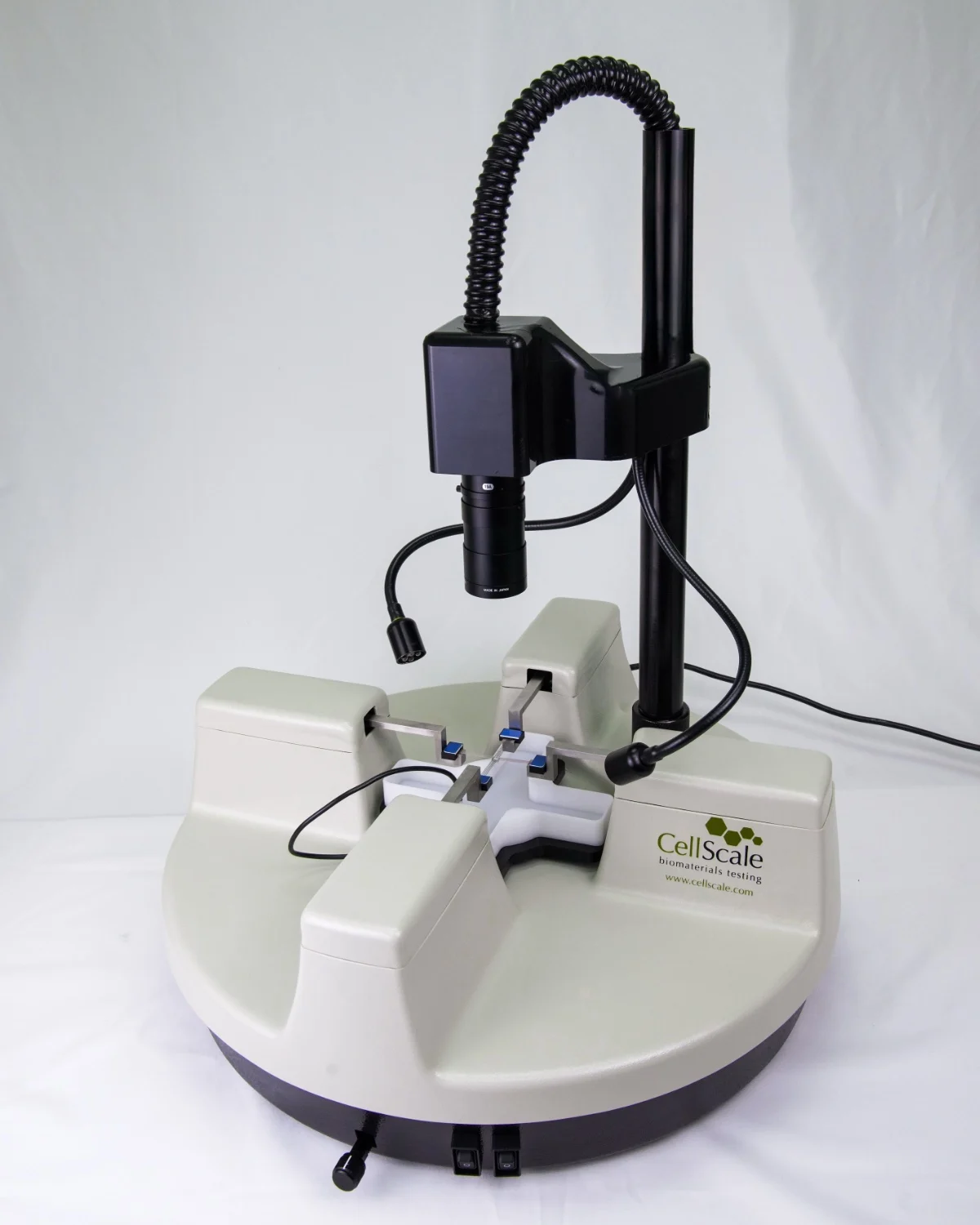
The BioTester is designed for planar biaxial mechanical testing of soft tissues, biomaterials, and compliant synthetic materials.
Different from a conventional uniaxial tester, it can apply controlled loading along two perpendicular axes. You can perform equibiaxial tests or use different loading conditions in each direction to investigate directional mechanical behaviour.
The current BioTester series has multiple models of different force capacities and configuration options. Researchers can use mechanical grips or our patented BioRakes, along with imaging and environmental testing accessories suited to your specimens.
The mechanical tester is used on many different soft materials, from native biological tissues to engineered polymer networks.
For example, a study of aortic aneurysm biomechanics used a BioTester to examine mechanical differences in human aortic tissue (which is a little different from synthetic biodegradable elastomer biaxial mechanical properties in the present study).
Explore the BioTester
If you’re planning to characterize a soft polymer, biomaterial, or engineered tissue in two directions, talk to our applications team about your specimen and loading protocol. We can discuss grips and force ranges and walk through the setup in a virtual demo!
Original Publication
F. Feyne, B. van Bochove, S. Spoljaric, M. Zidi, A. Aghaei, and A. R. de Anda, “ Multiscale Characterization by Equibiaxial Tensile Testing and Time-Domain 1H Solid State NMR for PTMC-Based Networks for Tissue Growth.” Macromolecular Materials and Engineering 311, no. 8 (2026): e70263. https://doi.org/10.1002/mame.70263