

Mechanical Testing Standards


What Are Mechanical Testing Standards?
Mechanical testing standards describe how a particular material property or product characteristic should be measured under controlled conditions. They help laboratories use consistent test procedures so that results can be compared across specimens, batches, research groups, or manufacturing environments.
- Depending on the standard, requirements may include:
A mechanical testing method and a mechanical testing standard are related, but they are not the same thing. Tensile testing, compression testing, flexural testing, and peel testing describe broad methods of applying mechanical load. ASTM and ISO test methods define how those methods are applied to specific materials, products, or measurements.

ASTM and ISO Mechanical Testing Standards
CellScale has developed and evaluated test configurations for a growing range of ASTM testing standards and ISO testing standards. The examples below include both general materials testing and specialized product testing.
Each standard has its own requirements. The appropriate test system, load cell, fixture, specimen preparation, and analysis procedure should therefore be considered individually.
ASTM Testing Standards
ASTM F88/F88M
Seal Strength of Flexible Barrier Materials
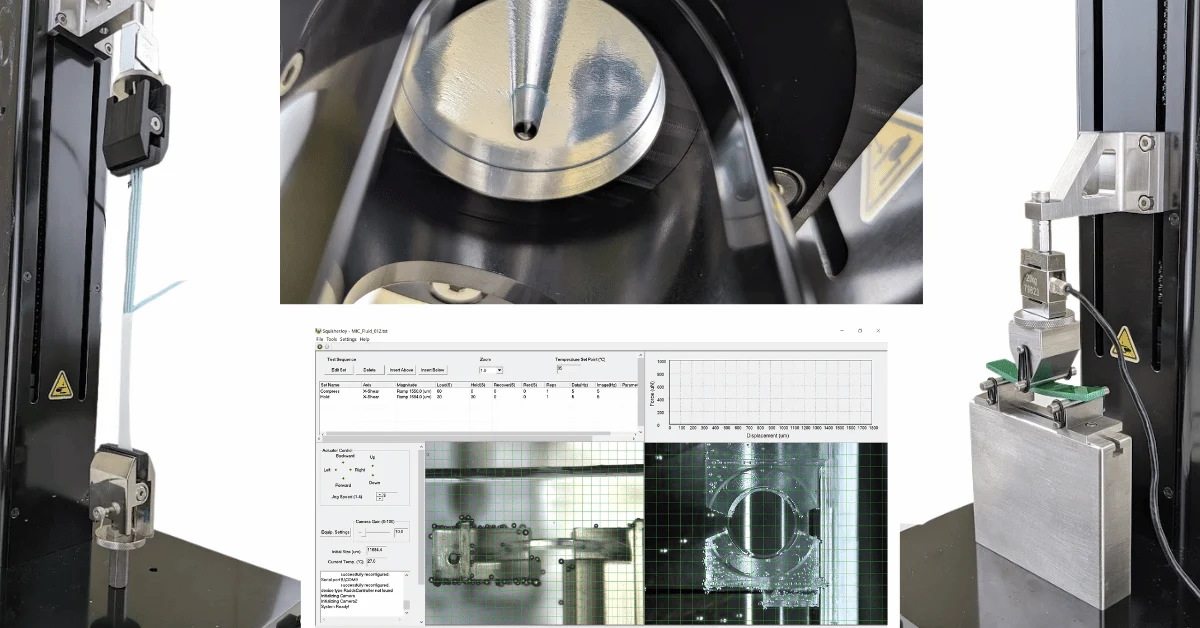
ASTM F88/F88M describes tensile testing of seals in flexible barrier materials. CellScale evaluated low-force seal separation using a UniVert S with a 2 N load cell and an unsupported Technique A configuration.
The study measured average peel force and maximum force across 12 sterilization-pouch specimens. An application-specific specimen orientation was used, so the work is presented as testing based on ASTM F88/F88M rather than a demonstration of full procedural conformance.
System: UniVert
Method: Peel / tensile separation
Evidence: CellScale experimental study
ASTM F1306
Slow Rate Penetration Resistance of Flexible Barrier Films and Laminates
ASTM F1306 is used to characterize the resistance of flexible barrier materials to slow-rate penetration. Testing requires controlled movement of a penetration probe while force and displacement are recorded.
CellScale has completed an experimental test program using the UniVert for this type of puncture and penetration testing.
System: UniVert
Method: Puncture / penetration
Evidence: CellScale experimental study
ASTM D790
Flexural Properties of Plastics
ASTM D790 covers flexural testing of plastics using controlled bending. Three-point loading is commonly used to measure the response of a specimen as it bends under an applied force.
CellScale has completed ASTM D790-based testing using the UniVert with a flexural test configuration.
System: UniVert
Method: Flexural testing
Evidence: CellScale experimental study
ISO Testing Standards
ISO 11979-3
Mechanical Properties of Intraocular Lenses
ISO 11979-3 includes mechanical testing requirements for intraocular lenses and their supporting haptics. These measurements involve small forces, controlled displacement, defined fixture geometry, and accurate observation of lens position.
CellScale previously developed a MicroTester-based configuration for intraocular lens testing to ISO 11979-3 requirements. The system combined low-force mechanical measurement with custom fixtures and imaging for the specialized geometry of the application.
System: MicroTester
Application: Intraocular lens testing
Evidence: CellScale case study
Mechanical Testing Standards by Test Method
Mechanical testing standards can also be grouped by the type of loading or material response being measured. A single CellScale system may support several test methods when equipped with the appropriate load cell and fixture.
Tensile Testing Standards
Tensile test standards define how specimens are loaded in tension and may specify dimensions, test speed, strain measurement, calculations, and reporting. Applications range from rigid plastics to thin films, elastomers, fibers, and flexible materials.
Compression Testing Standards
Compression standards are used to characterize materials and products under compressive loading. Depending on the material, measurements may include force, stress, deformation, stiffness, or other compression-related properties.
Peel and Seal Strength Testing Standards
Peel and seal testing standards are used for bonded interfaces, flexible packaging, tapes, adhesives, and related materials. Test configuration can have a strong influence on the measured force, particularly when specimen geometry or peel angle changes.
Flexural Testing Standards
Flexural standards evaluate material behaviour under bending. These methods are commonly used with plastics and other relatively stiff specimens and may define support span, specimen dimensions, loading geometry, and test rate.
Puncture and Penetration Testing Standards
Puncture and penetration tests measure how a material responds to a localized probe or indenter. These methods are useful for films, packaging materials, membranes, and other specimens where resistance to localized loading is important.
Friction Testing Standards
Friction standards are used to measure the resistance to sliding between two surfaces. Test procedures may distinguish between static and kinetic friction and typically require controlled movement and a defined contact configuration.
How to Choose a Mechanical Testing Standard
The appropriate standard depends on more than the general type of test. Material form, specimen geometry, intended measurement, and the purpose of the results can all affect which procedure is suitable.
The applicable standard and revision should always be confirmed using the official document published by the relevant standards organization.
Material or Product
A standard may be written specifically for a film, rigid plastic, foam, elastomer, adhesive, medical device, textile, or finished component. Similar mechanical properties may be measured differently for different material forms.
Mechanical Property
Start with the property that needs to be measured. Examples include tensile strength, seal strength, flexural behaviour, compression response, penetration resistance, peel force, or friction.
Specimen Geometry and Test Configuration
Standards may specify specimen width, thickness, gauge length, orientation, fixture geometry, support spacing, loading direction, or other dimensions that influence the test result.
Application and Reporting Requirements
Research, product development, manufacturing quality control, customer specifications, and regulated applications may have different requirements for procedure, documentation, and reporting.
Equipment for ASTM and ISO Mechanical Testing
Standards-based testing requires more than selecting a machine with enough maximum force capacity. The test system, sensor, fixtures, motion range, and measurement method all need to suit the procedure being performed.
Mechanical Test System and Motion Control
The test system must provide the loading mode, travel, speed, and positional control required by the standard. Some procedures involve short, low-force movements, while others require substantially more travel or higher loads.
Load Cell and Force Measurement
An appropriate load cell should provide enough capacity for the expected maximum load while maintaining useful measurement performance over the force range of interest.
This becomes especially important in low-force testing. During CellScale’s ASTM F88 study, initial trials with a higher-capacity load cell produced more apparent signal noise than testing with a 2 N load cell. The lower-capacity sensor provided a clearer measurement of the seal-peeling response.
Grips and Fixtures
The correct fixture depends on the test method and specimen. Common examples include:
- tensile grips
- compression platens
- flexural fixtures
- peel configurations
- puncture fixtures
- application-specific or custom fixtures
Fixture geometry and specimen alignment should remain consistent when comparing results.
Measurement and Data Acquisition
Force, displacement, strain, and image-based measurements may all be relevant depending on the standard. Data acquisition rate and analysis method should also be selected with the expected material response and reporting requirements in mind.
ASTM and ISO Testing with CellScale Systems
CellScale mechanical testing systems are designed to support a range of specimen sizes, force levels, fixtures, and test configurations. The most appropriate system depends on the standard and the material being evaluated.
UniVert
The UniVert is a configurable mechanical testing system used for tension, compression, flexural, peel, puncture, and other mechanical test methods. Interchangeable load cells and fixtures allow the system to be adapted for different materials and force ranges. Researchers use the UniVert to test hydrogels, elastomers, soft polymers, scaffolds, tissues, medical materials, and other compliant specimens across static and dynamic workflows.
MicroTester
The MicroTester is designed for small specimens and low-force mechanical testing where precise motion, imaging, and specialized fixture geometry may be required. Researchers use the MicroTester for hydrogels, bioinks, tissue sections, spheroids, microfabricated constructs, and other small samples where force sensitivity and sample visualization are important.
Custom Testing Configurations
Some standards require fixture geometries or measurement approaches that are not part of a conventional tensile or compression setup. CellScale can work with researchers and engineers to evaluate application-specific requirements and determine whether an existing fixture or custom configuration is appropriate. Researchers use the BioTester to study directional mechanical behaviour, strain response, and mechanical properties of sheet-like soft materials.
Standards-Based Testing and Procedural Conformance
A mechanical test system may be capable of meeting the equipment and measurement requirements relevant to a standard without every test performed on that system constituting full procedural conformance.
Conformance can depend on several parts of the procedure, including:
- the specific revision of the standard
- specimen preparation and dimensions
- conditioning and fixture geometry
- loading rate and other test parameters
- measurement accuracy, analysis method, and reporting
- any modifications made for the application
For this reason, CellScale standards pages describe the configuration that was evaluated, the testing that was performed, and any application-specific changes that affect how the results should be interpreted.
For example, CellScale’s ASTM F88 study used an application-specific specimen orientation to obtain a continuous peel response from the sterilization pouch geometry being evaluated. The study therefore demonstrates seal strength testing using conditions based on ASTM F88/F88M, rather than full procedural conformance to the standard.
Mechanical Testing Standards FAQs
What are mechanical testing standards?
Mechanical testing standards define procedures for evaluating material or product behaviour under controlled mechanical loading. Depending on the standard, they may specify specimen preparation, test speed, fixtures, measurement requirements, calculations, and reporting.
What is the difference between ASTM and ISO standards?
ASTM International and the International Organization for Standardization publish standards used across many industries. Both organizations publish mechanical test methods, but the scope, terminology, procedures, and intended applications of individual standards can differ. The appropriate standard depends on the material, product, industry, and testing requirement.
What is the difference between a mechanical testing method and a testing standard?
A mechanical testing method describes the general way a load is applied, such as tensile, compression, flexural, or peel testing. A testing standard defines a specific procedure for using that method with a particular material, product, or measurement objective.
What ASTM standards are used for mechanical testing?
ASTM publishes mechanical testing standards covering many materials and test methods, including tensile, compression, flexural, peel, puncture, friction, and other forms of mechanical characterization. The correct standard depends on the material and property being measured.
What ISO standards are used for mechanical testing?
ISO publishes standards for mechanical characterization across a wide range of materials, components, and products. Some are broad materials test methods, while others are highly application-specific, such as ISO 11979-3 for the mechanical properties of intraocular lenses.
Can one mechanical testing system perform multiple ASTM or ISO test methods?
Yes, when the system has the required force range, motion capability, fixtures, measurement accuracy, and test control. A configurable system such as the UniVert can support several different mechanical test methods by changing the load cell, fixture, and test protocol.
What equipment is needed for ASTM or ISO mechanical testing?
The required equipment depends on the individual standard. Common requirements may include a mechanical test frame, an appropriately sized load cell, grips or fixtures, displacement or strain measurement, environmental control, imaging, or specialized specimen supports.
Does using ASTM- or ISO-capable equipment mean a test is fully compliant with the standard?
No. Equipment capability is only one part of standards-based testing. Full procedural conformance may also depend on specimen preparation, conditioning, test parameters, fixture geometry, calculations, reporting, and the specific revision of the standard being followed.
Need to Test to a Specific ASTM or ISO Standard?
Testing requirements can vary considerably between materials and standards. If you are evaluating a specific ASTM or ISO test method, our applications team can review your material, expected force range, specimen geometry, and test requirements to help determine an appropriate CellScale system and fixture configuration.