GelMA bioink mechanics are one of the key factors that determine whether a 3D bioprinted construct will hold its shape, cure effectively, and perform under physiological conditions. In practice, tuning a bioink means balancing viscosity, crosslinking behaviour, swelling, degradation resistance, and mechanical response. That challenge is especially important for methacrylated gelatin, or GelMA, because it is widely used in bioprinting thanks to its bioactivity and tunable properties.
In this study, researchers at the University of Waterloo investigated how chloride salts and hydroxyapatite nanoparticles changed the behaviour of GelMA-based inks and hydrogels. CellScale contributed to the work through the use of the UniVert, which was used in cyclic compression to measure dynamic modulus, storage modulus, and loss modulus. That mechanical testing helped show how bioink formulation influenced the final hydrogel response.
Read more about Compression Testing and Bioink & 3D Bioprinting Materials.
Why GelMA bioink mechanics matter
The performance of a printed hydrogel depends on more than whether it can be extruded or photocured. A useful bioink also needs enough structural integrity to remain stable after printing and enough mechanical relevance to support the intended tissue application. That is why GelMA bioink mechanics are so important in formulation development.
This study looked at three formulation variables that could influence that outcome:
- chloride salts, including NaCl and CaCl2
- hydroxyapatite nanoparticles
- the resulting effects on swelling, curing, and dynamic mechanical behaviour
The rationale is straightforward. Calcium ions were expected to affect viscosity and photocuring more strongly than sodium ions, while hydroxyapatite was expected to act as a reinforcing mineral phase within the gelatin network.
What the researchers tested
The paper examined GelMA-based solutions and inks containing different levels of NaCl, CaCl2, and hydroxyapatite nanoparticles. The team then evaluated viscosity, UV curing, swelling in distilled water, and dynamic mechanical response of the cast hydrogels.
That combination makes this a useful formulation study rather than just a single-property report. It links 3D bioprinting GelMA composition to both process-related behaviour and final hydrogel mechanics.

How the CellScale UniVert was used
CellScale’s role in the study came through the UniVert, which was used to mechanically evaluate the cured GelMA hydrogels. The system was run in cyclic sinusoidal compression between 0 and 8% strain at 0.01 Hz, allowing the researchers to determine dynamic modulus, storage modulus, and loss modulus.
The UniVert was used to quantify the mechanical outcome of the different GelMA formulations, not just their printability or curing response. That makes this a strong example of hydrogel mechanical testing supporting bioink development.
For a related mechanics-focused post, see hydrogel stiffness measurement.
How salts and nanoparticles changed the bioink
The study was built around the idea that seemingly simple formulation changes can have a large effect on hydrogel performance. Calcium chloride was expected to have a stronger effect than sodium chloride because divalent ions can interact more strongly within the matrix. Hydroxyapatite nanoparticles were added as a reinforcing mineral phase to improve the mechanical behaviour of the printed gel.
That makes this paper especially useful for readers interested in methacrylated gelatin bioink optimization. It shows that bioink tuning is not just about adding more material, but about understanding how ionic composition and particle reinforcement influence the network as a whole.
Dynamic mechanical testing was the key result
The most important outcome of the paper is the dynamic mechanics story. The authors used the UniVert results to compare dynamic modulus across GelMA formulations containing different salt and nanoparticle levels. That allowed them to directly connect formulation design to functional hydrogel response.
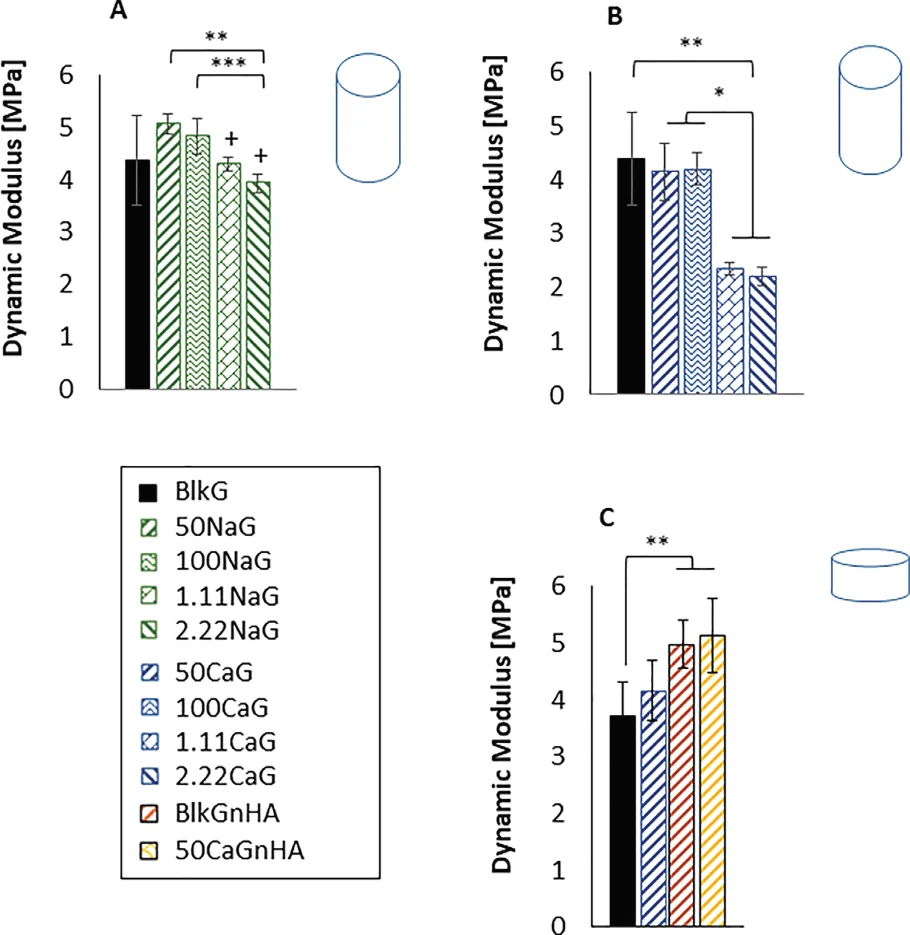
The paper is not just about printing or chemistry. It is about tuning mechanical performance in a GelMA-based system so that the final hydrogel better matches the needs of engineered tissue applications.
Matching articular cartilage mechanics
One of the strongest takeaways from the study is that the team achieved 3D printed hydrogels with dynamic modulus matching that of articular cartilage. According to the summary provided, this was a first for a GelMA-based composite system.
For a related 3D bioprinting article, see rotary 3d bioprinting bioink.
Why this matters for 3D bioprinting
The broader significance of the work is that it shows how GelMA bioink mechanics can be tuned through relatively accessible formulation variables. Salts and reinforcing nanoparticles changed how the material behaved during curing, swelling, and cyclic loading, which is exactly the sort of information needed when moving from a printable hydrogel to a tissue-relevant construct.
For cartilage, osteochondral, and other load-bearing soft tissue applications, that mechanical tuning is especially important. A bioink that prints well but does not achieve the right modulus may still fall short in practice.
Final thoughts
This study connects GelMA bioink mechanics to 3D bioprinting formulation, hydrogel reinforcement, and dynamic mechanical testing, while also highlighting the role of the UniVert in measuring the resulting hydrogel behaviour.
The clearest message is that salts and nanoparticles can be used to tune GelMA systems in a mechanically meaningful way, and that this tuning helped produce a GelMA-based composite with dynamic modulus matching articular cartilage. That makes the study especially relevant for bioink development and tissue engineering audiences.
Read the full journal article here: Printability of Methacrylated Gelatin upon Inclusion of a Chloride Salt and Hydroxyapatite Nano-Particles
Read about Dr Willett’s and Dr Comeau’s research here: Waterloo Composite Biomaterial Systems Lab
For related reading, you may also like: