Intra-Ocular Lens Mechanical Testing System for ISO-Standard Haptic Compression
Medical Device R&D Group (Confidential Client)
Custom system designed for internal design verification and quality testing. Client name withheld due to internal QA and regulatory workflows.
Project Background
Intraocular lenses are implanted into the eye during cataract surgery, and their mechanical behaviour directly influences stability, centration, and long-term performance.
Lense manufacturers must therefore evaluate mechanical properties such as:
- Haptic compression force
- Axial displacement under compression
- Optic decentration
- Optic tilt
- Durability and loop behaviour
These measurements are defined in the global industry standard ISO 11979-3:2012, which specifies test requirements, apparatus geometries, and reporting criteria for IOL compression tests and mechanical characterization as a whole.
A medical device R&D group approached CellScale to build a precision testing system capable of:
- Intraocular lens mechanical testing
- Controlled radial haptic compression measurement
- Accurate micro-Newton force measurement
- Multi-angle video capture of deformation
- Quantitative displacement tracking
- Reproducible alignment and mounting of lenses
The system needed to support method development, quality assurance, and design verification workflows.
The Challenge
1. ISO-Defined Geometric Requirements
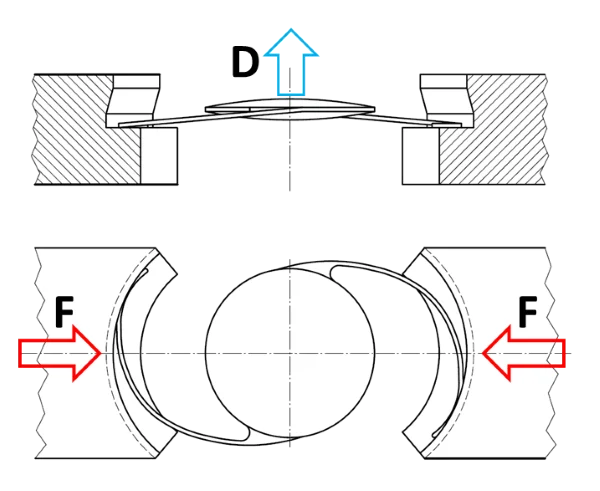
ISO 11979-3 mechanical testing specifies that compression must be applied using aligned anvils with specific radii, spacing tolerances, and low-friction surfaces. The testing setup had to reproduce these geometries while allowing smooth, controlled displacement during intraocular lens mechanical testing.
2. Precise Radial IOL Compression Test and Force Measurement
IOL haptics exert very small forces, requiring micro-scale sensitivity during compression to prescribed diameters of 10 mm or 11 mm depending on lens type.
3. Multi-Angle Imaging for Qualitative Assessment
The customer needed both overhead and axial imaging to record loop deformation, optic bending, and haptic compression measurement.
4. Reproducible Specimen Alignment
IOLs are extremely delicate. The system required a mounting approach that ensured consistent positioning without introducing unintended stresses.
5. Software Integration and Visualization
Live imaging, force–displacement curves, and synchronized video needed to appear in a single software environment.
Custom Solution Developed by CellScale
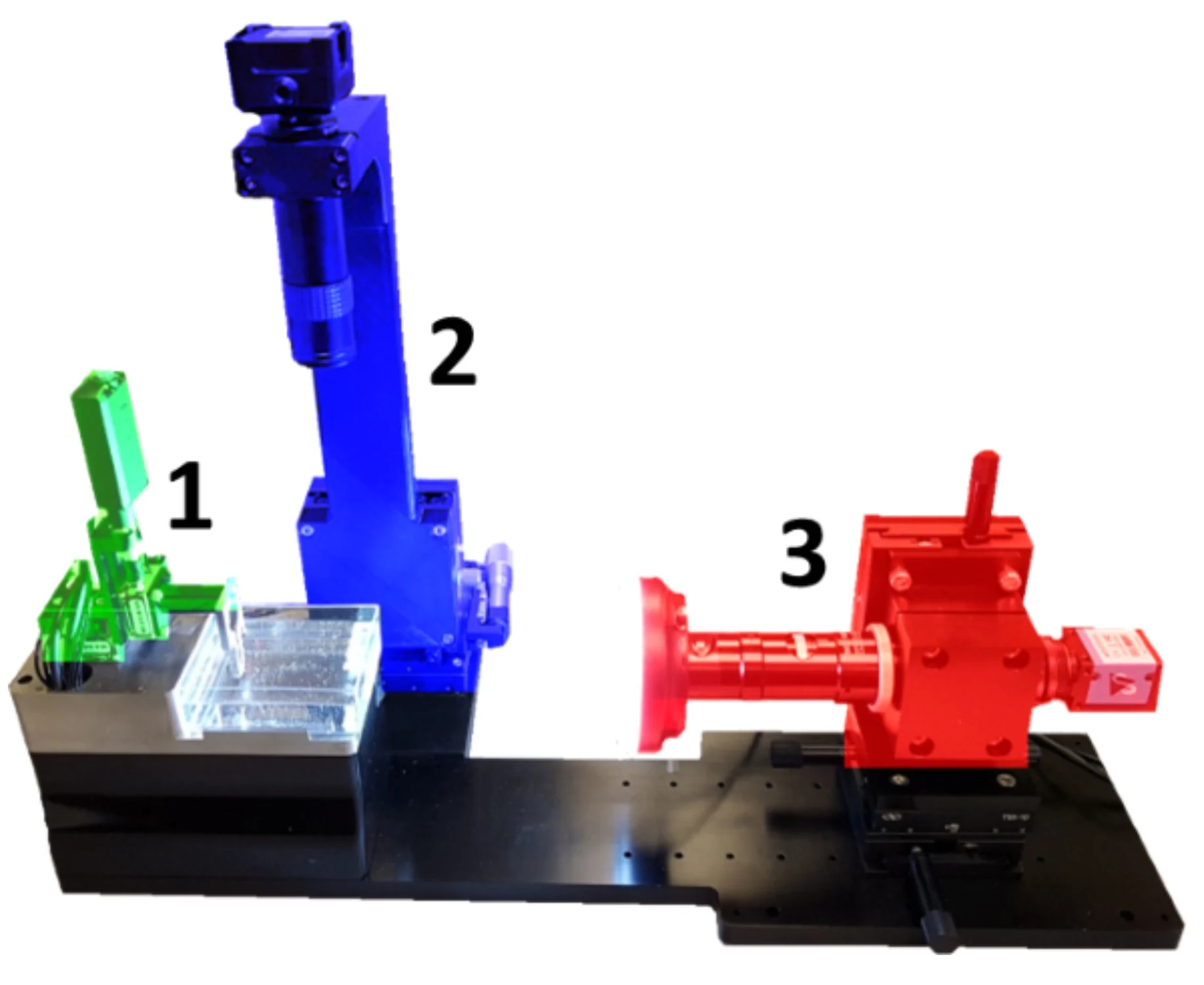
Precision Compression Fixture (Component 1)
A custom machined fixture reproduced the ISO-specified anvil geometry and alignment. This allowed:
- controlled radial compression of haptics
- accurate measurement of force decay and stiffness
- repeatable positioning of lenses for multiple tests
The fixture followed the geometry principles, including the requirement for minimal rotational constraint during loop compression.
Overhead Imaging System for Shape and Alignment (Component 2)
A vertical camera captured top-down views of:
- loop symmetry
- optic decentration characteristics
- deformation during the IOL compression test
This angle is especially helpful for visualizing contact angles.
Axial Imaging System for Tilt and Vertical Motion (Component 3)
A second camera was mounted horizontally to monitor:
- optic tilt
- loop motion and bending
- axial displacement under compression
This view is essential for interpreting optic behaviour as defined in the standard.
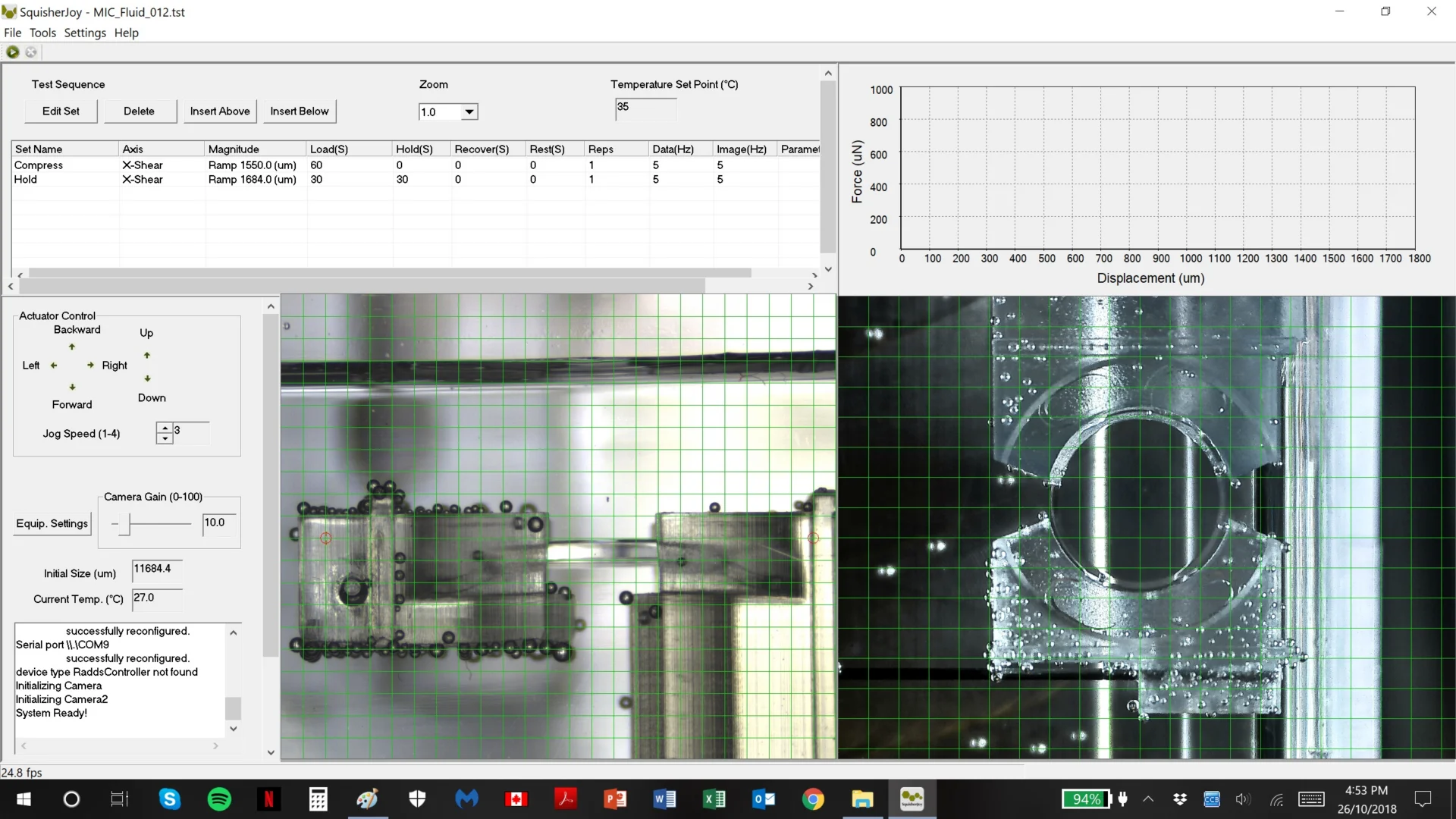
Integrated Software Interface
The MicroTester software displayed:
- synchronized multi-camera feeds
- live force–displacement curves
- sequential compression steps
- repeatable test templates
Researchers could capture data suitable for internal QA, R&D evaluations, or regulatory documentation.
Results and Impact
The custom IOL testing system allowed the customer to:
1. Evaluate haptic compression force with high repeatability
The MicroTester provided micro-force resolution appropriate for measuring the low compression forces described in ISO 11979-3 mechanical testing.
2. Capture multi-angle deformation during compression
Dual imaging enabled qualitative and quantitative assessment of lens behaviour not easily captured by single-camera systems.
3. Perform controlled axial displacement tests
The horizontal imaging path matched requirements for observing axial movement during compression.
4. Support design verification and refinement
The system allowed MedTech engineers to compare prototypes, validate material choices and evaluate performance under defined mechanical constraints.
5. Streamline regulatory compliance workflows
Although the system was not itself a certified ISO testing apparatus, it enabled the development and execution of ISO-aligned test methods that follow the geometry and measurement principles outlined in the standard.
Key Capabilities Enabled
Multi-angle imaging for optic and haptic mechanics
Controlled compression to ISO-specified diameters
Micro-scale force and displacement measurement
Custom fixturing for delicate polymer components, with reproducible mounting and alignment
Synchronized data and video output
Interested in a Similar Custom Solution?
CellScale engineers collaborate with medical device teams to develop precise mechanical testing solutions for early-stage research through regulatory preparation.