

Vascular Tissue Engineering
and Aortic Biomechanics


Overview of Vascular Tissue Engineering and Aortic Biomechanics
Vascular tissue engineering focuses on creating functional blood vessels and vascular grafts that replicate the mechanical behaviour of native arteries and veins. Researchers study aortic wall mechanics, vessel anisotropy, extracellular matrix organization, and the dynamic response of engineered constructs to pulsatile forces. Understanding these mechanical properties is essential for predicting graft performance, remodeling, and long-term durability.
- Key mechanical considerations in vascular biomechanics:
Mechanical behaviour such as stiffness, circumferential versus axial compliance, viscoelasticity, and nonlinear strain response directly influences hemodynamics, wall shear stress, and cellular mechanotransduction. In aortic biomechanics research, testing supports studies of aneurysm progression, hypertensive remodeling, age-related stiffening, and localized structural weakness that predisposes regions to failure.

Why Mechanical Testing Matters in Vascular Tissue Engineering
Mechanical testing plays an essential role in evaluating vascular grafts, engineered tissues, and native vessels.
It provides quantitative data that help researchers:
- Determine whether engineered grafts match native vessel stiffness and compliance
- Assess how aortic tissues remodel during aneurysm formation or hypertensive loading
- Characterize age related changes in vessel wall mechanics
- Evaluate the durability and fatigue resistance of tissue engineered grafts
- Support finite element models for predicting aortic rupture risk
- Study how mechanical cues regulate smooth muscle cell behaviour and ECM turnover
Accurate mechanical profiles help designers improve graft materials, optimize scaffold structure, and prevent complications caused by compliance mismatch.
Recommended CellScale Instruments for Vascular Tissue Engineering

BioTester
Used for biaxial testing of vessels and aortic tissue, allowing precise control of planar loading and measurement of anisotropic behaviour.

UniVert
Provides uniaxial tensile testing for circumferential or axial vessel strips, engineered graft materials, and vascular scaffolds.
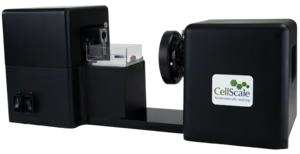
MicroTester
Suitable for testing thin hydrogel coatings, micro-scale vascular scaffolds, and small engineered constructs used in graft development.

MechanoCulture TR
Applies hydrostatic pressure stimulation for studying vascular mechanobiology under physiologically-relevant conditions.
Testing Methods Used in Vascular and Aortic Biomechanics
Biaxial Testing
Evaluates anisotropy and multi directional stiffness of vessels and aortic tissue
Hydrostatic Pressure Testing
Applies physiologic luminal pressure
Tension Testing
Characterizes circumferential or axial properties
Indentation Testing
Assesses local stiffness gradients across the vessel wall
Pressure Testing
Evaluates vessel compliance, circumferential stiffness, and failure behaviour under controlled inflation
Representative Sample Types in Vascular Tissue Engineering
Native tissues
- Aortic wall samples
- Pulmonary artery segments
- Carotid vessels
- Venous tissue
Engineered materials
- Vascular graft scaffolds
- Hydrogel-coated grafts
- Decellularized vascular matrices
- Composite polymer grafts
Disease models
- Aneurysmal aortic tissue
- Hypertension models
- Age-related stiffening samples
Recent Publications in Aortic Biomechanics and Vascular Tissue Engineering

Advance Your Work in Vascular Tissue Engineering
Our testing platforms support detailed mechanical evaluation of native vessels, engineered grafts, and aortic tissues. Contact our team to discuss your research needs or explore instrument recommendations.
