

Indentation Testing
For Soft Tissues and Biomaterials

Indentation testing provides a powerful method for quantifying local stiffness, viscoelasticity, and depth-dependent mechanical behaviour in soft tissues, hydrogels, and compliant biomaterials.
Because indentation testing applies controlled force or displacement through a small contact area, it enables researchers to map spatial variations in mechanical properties and evaluate thin, fragile or irregularly shaped samples that cannot be tested using standard uniaxial methods.

What Is Indentation Testing?
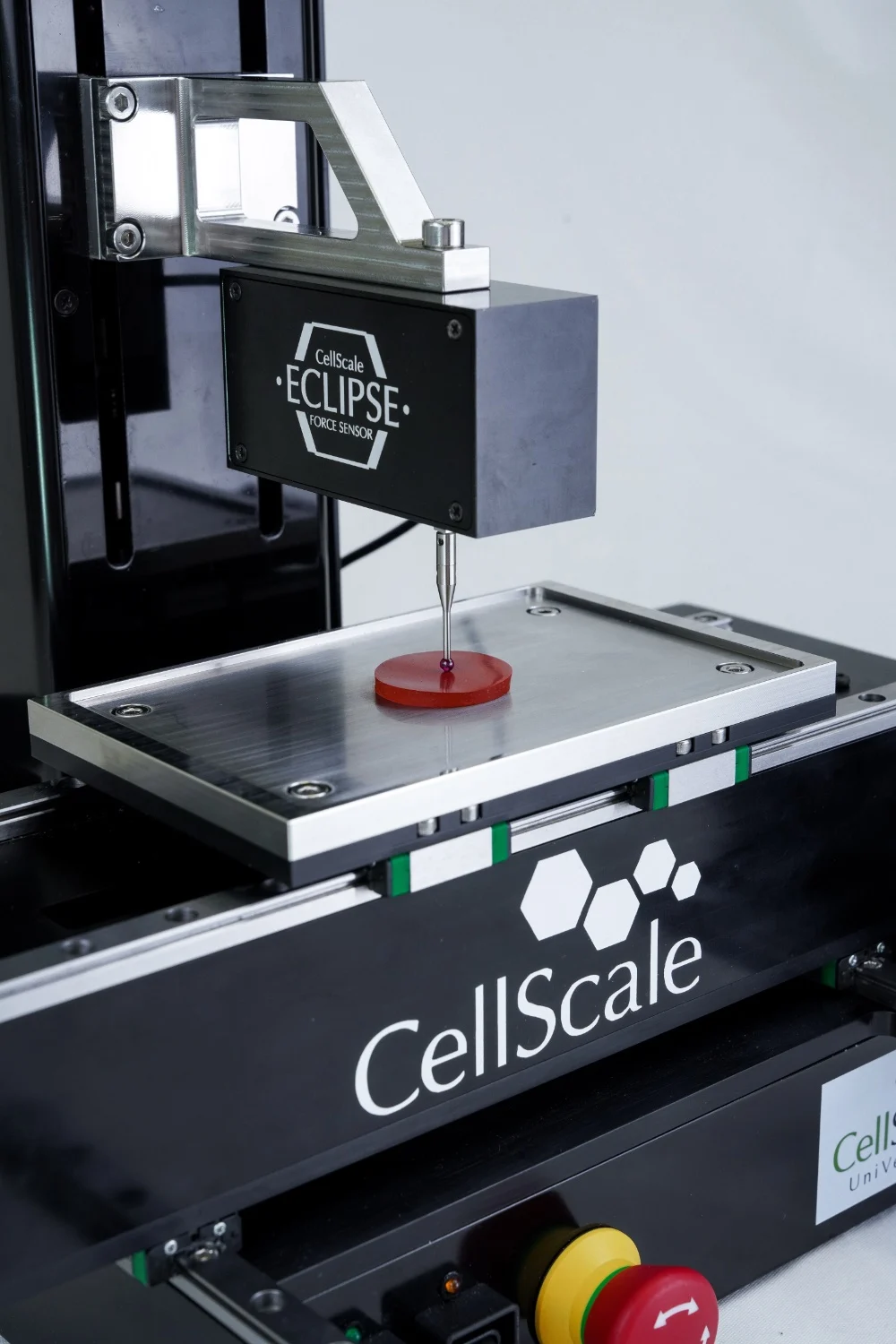
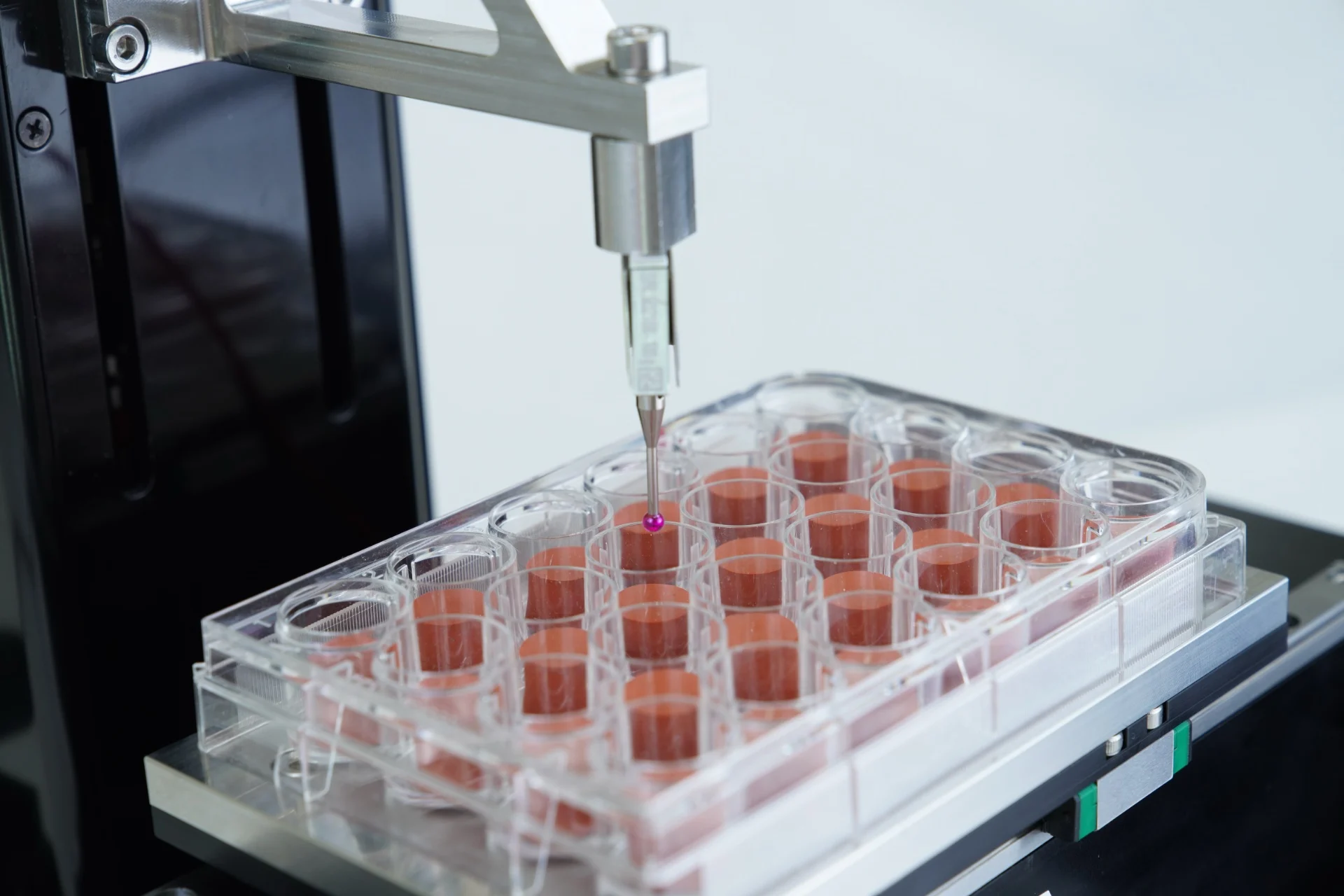
Indentation testing involves pressing a rigid indenter into the surface of a material while measuring force and displacement. In a typical indentation test, the applied load and resulting displacement are recorded to characterize material response at the point of contact. The resulting curves can be used to derive:
Measurement Examples
- Apparent modulus
- Local stiffness
- Indentation hardness
- Viscoelastic response
- Time dependent deformation
- Creep and relaxation behaviour
- Effects of hydration or degradation
For soft biomaterials, indentation testing is often preferred over traditional tensile testing because samples may be too small, irregular or delicate to grip. Instrumented indentation enables reproducible mechanical measurements in hydrated environments and at micro-Newton to Newton force levels.
Indentation Testing for Biomaterials Research
Indentation testing is widely used across soft tissue biomechanics, mechanobiology, and biomaterials research where mechanical properties vary spatially or samples cannot be gripped. This approach is especially useful for probing local mechanical properties in heterogeneous tissues and biomaterials.
- Localized stiffness and depth-dependent mechanics
Indentation captures regional variations in stiffness within tissues, hydrogels, and engineered constructs, including gradients in crosslinking density or cellular organization.
- Minimal sample preparation
Hydrogels, tissues, and delicate biomaterials can be tested without trimming or clamping, preserving native structure and hydration.
- Thin and fragile specimen compatibility
Films, membranes, corneal tissue, and micro-scale samples that cannot withstand tensile loading can be mechanically characterized using indentation.
- Hydrated and physiologic testing conditions
Indentation testing is routinely performed in fluid environments to preserve biologic relevance and material integrity.
- Imaging-compatible mechanical analysis
Indentation setups integrate with optical imaging to correlate force response with deformation, surface motion, or structural features.
Sample Types Suitable for Indentation Testing
- Thin hydrogels
- Cell laden constructs
- Bioinks and printed materials
- Corneal tissue and sclera
- Cartilage zones and osteochondral tissue
- Biodegradable polymers
- Thin films and membranes
- Micro-scale engineered tissues
How an Indentation Test Works
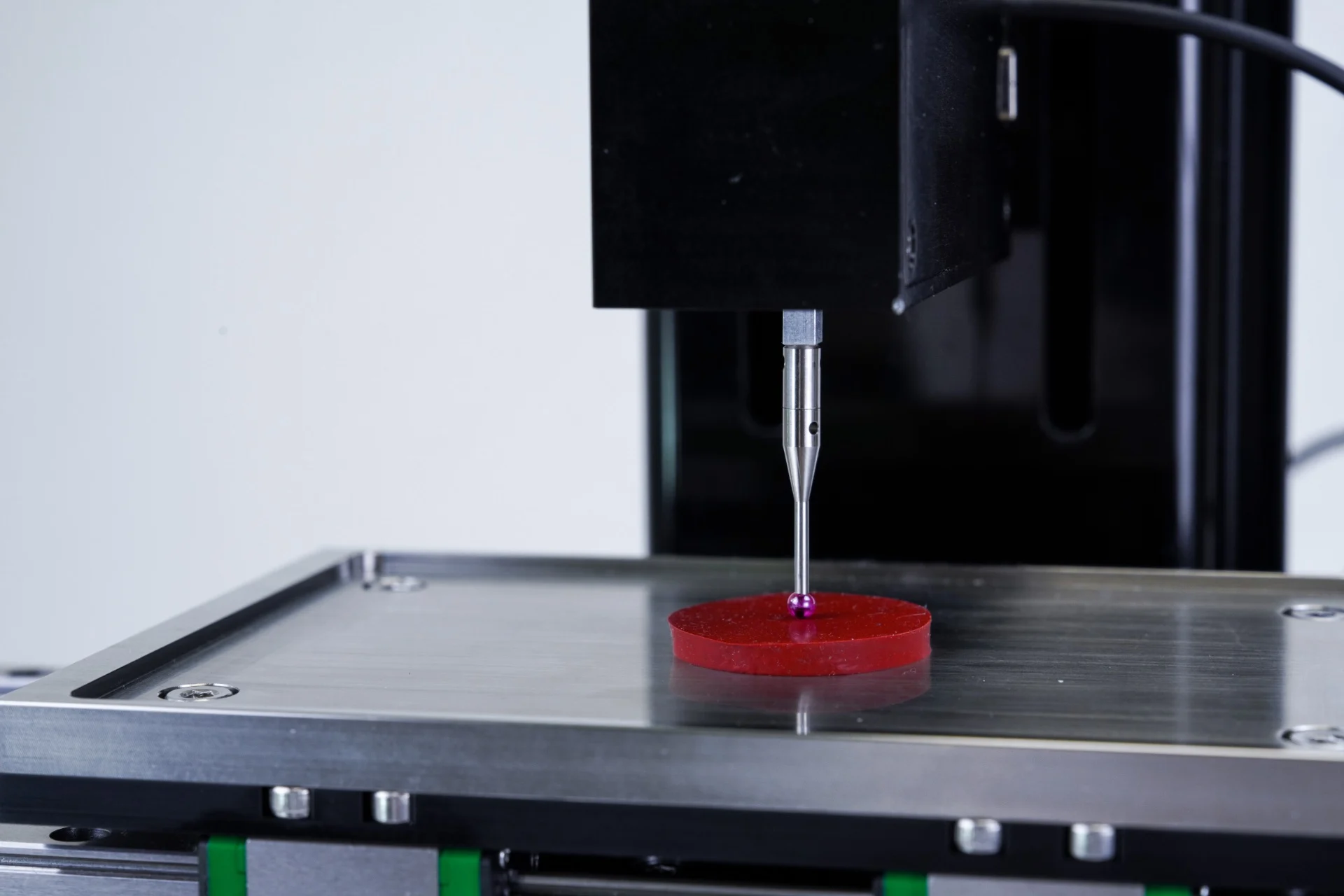
Indentation testing applies controlled force or displacement through a defined indenter geometry while recording the material response. Resulting force-displacement data are used to derive stiffness, modulus, and time-dependent behaviour.
Force-controlled and displacement-controlled indentation
Protocols can apply load-controlled ramps, displacement steps, or cyclic indentation depending on the material and research objective. At very small length scales, nano indentation protocols are used to resolve mechanical behavior in thin films, microtissues, and soft interfaces.
Indenter geometry selection
Spherical, flat-punch, or conical indenters are selected based on sample thickness, expected deformation, and analytical model.
Time-dependent and viscoelastic protocols
Hold steps and cyclic loading enable measurement of creep, stress relaxation, and mechanical recovery.
Spatial mapping and stiffness profiling
Indentation arrays allow stiffness mapping across tissues, hydrogels, or injury zones to reveal heterogeneity and anisotropy.
Recommended Instruments for Indentation Testing
The below CellScale systems support instrumented indentation testing for measuring local stiffness and viscoelastic behaviour across soft tissues and biomaterials.
UniVert
Relevant Research Applications
These research applications routinely use indentation testing:
Featured Publications Using Indentation Testing
Related Testing Methods
Indentation testing complements bulk mechanical tests by revealing localized properties.
Ready to Perform Indentation Testing?
CellScale instruments support precision indentation testing across hydrogels, soft tissues and advanced biomaterials.