Molecularly-ordered Hydrogels with Controllable Response

A tensile test divider icon

In this research from Dr Taylor Ware and his team at the University of Texas at Dallas, small hydrogels of chromonic properties morph into programmed shapes in response to pH and temperature stimuli.

CellScale hexagon shapes

In the field of biosensors, artificial muscles and microfluidics, shape-morphing hydrogels are of significant interest. Isotropic materials can be morphed into complex shapes under aqueous stimuli by varying the material (embedding with stiff particulate such as carbon nanotubes for example) or the processing (angled lamination).

While the challenge exists to create and control such hydrogels at a micro-size, Taylor Ware and his team at the University of Texas at Dallas have successfully created anisotropic hydrogels by polymerizing oriented chromonic liquid crystals. The team demonstrated control over magnitude of shape change, stimulus to which the gel responds, and complexity of the liquid crystal orientation.
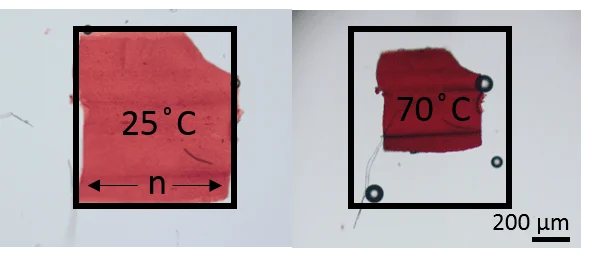
Key to these anisotropic hydrogels is the patterned order imparted by chromonic liquid crystals. This patterned order was quantified by testing the axis-dependent mechanical properties, which is a difficult task in thin, compliant hydrogels. The team used the CellScale MicroTester with a temperature-controlled water bath setup to measure and subsequently derive the Young’s Modulus.

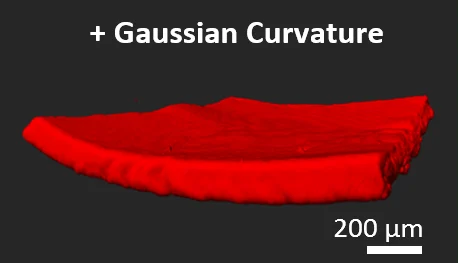
Stimulus in this experiment were pH and temperature, as determined by the choice of responsive comonomer. From the image below, approximately 70% and 50% dimensional changes are seen perpendicular to the alignment direction versus along the alignment direction in response to increased temperature. Varying the pH from acid to base saw approximately 100%/80% dimensional change (image above). Leveraging this knowledge, the team went further to create a microstructure that would exhibit positive or negative Gaussian curvature in response to certain conditions.


Read the full journal article here.

To read research on the biomechanical impact of localized corneal cross-linking, click here.

CellScale hexagons, without text

CELLSCALE INSTRUMENT USED

TAGS

Anisotropic hydrogels, hydrogel mechanics, MicroTester, pH-responsive materials, Shape-changing hydrogels, Smart materials, soft robotics materials, Stimuli-responsive materials, Temperature-controlled testing

POST DETAILS
CATEGORY

Research Highlights

INSTRUMENT USED
MicroTester
RESEARCH APPLICATIONS
Hydrogel Mechanical TestingSoft Robotics MaterialsStimuli Responsive Hydrogels Characterization
TESTING METHODS
Hydrated and Temperature Controlled TestingMicro-Mechanical Testing

Related Posts:

Filter by Category:
Filter by Instrument
Filter by Testing Method:
Filter by Research Application:
UniVert performing hydrated tensile testing on a glowing hydrogel optical fibre mounted between grips in a fluid bath.

July 16, 2026

Hydrogel Optical Fiber Testing Under Repeated Strain

Bioprinted meniscus tissue engineering construct with curved collagen-like alignment patterns in the foreground and a softly blurred CellScale BioTester in the background.

July 2, 2026

Meniscus Tissue Engineering with Boundary-Guided Collagen Alignment

Hydrogel fiber mechanical testing setup showing a thin hydrated fibre suspended across two supports while a small MicroTester beam presses downward in the centre, before and after.

June 25, 2026

Hydrogel Fibre Mechanical Testing of Recombinant Hagfish Protein Materials

MSC spheroids embedded in a translucent PEG-fibrin hydrogel within soft vocal fold-like tissue, with a blurred CellScale MicroTester in the background.

June 11, 2026

Vocal Fold Regeneration with MSC Spheroids

Hydrogel eye drop on a corneal surface with a mechanical testing probe and force-distance curve representing mucoadhesion testing for ocular drug delivery.

May 28, 2026

Mucoadhesion Testing of Hydrogel Eye Drops for Ocular Drug Delivery

May 14, 2026

Flexible Flow Sensor Testing for Pioneering Autonomous Robotics

Contact Sales

Product of Interest:
CellScale hexagon shapes