


Prediction of Hyperelastic Material Properties of Fuel Cell Membranes

A tensile test divider icon

In the automotive industry, the use of fuel cells is gaining popularity, so thus the understanding of the mechanical properties of the membranes in those fuel cells. Dr. Nemavhola and Dr. Sigwadi from the University of South Africa presents to us a systematic and analytical study of various material models on 2 types of membranes.

CellScale hexagon shapes

Proton-Exchange Membrane Fuel Cells is a favourable alternative to the internal combustion engines in vehicle applications. It was initially developed by General Electric for NASA for use in the Gemini spacecraft (ScienceDirect). In this system, thin, conductive membranes are used to transport protons from the electrolyte to the cathode. Commercial membranes such as Polymer Nafion® are available, although challenges are present to develop optical mechanical/conductive properties for their function as well as determining the appropriate law to characterize their material properties from a vast number of material models.

Dr. Fulufhelo Nemavhola and Dr. RA Sigwadi from the University of South Africa have achieved in this study a comprehensive review of 6 hyperplastic material models on 2 types of membranes – commercial  Nafion®117 and one treated with zirconium oxide. Uniaxial tensile tests up to 40% strain were conducted using the CellScale UStretch (now upgraded to the UniVert). From them, force and displacement data could be gathered to calculate stress and strain. They were then input into each material model to calculate the materials constants. The team further performed an error analysis between experiment and fitted data, concluding that one particular model has exhibited best fit and could thus be used to describe the membrane mechanical properties.
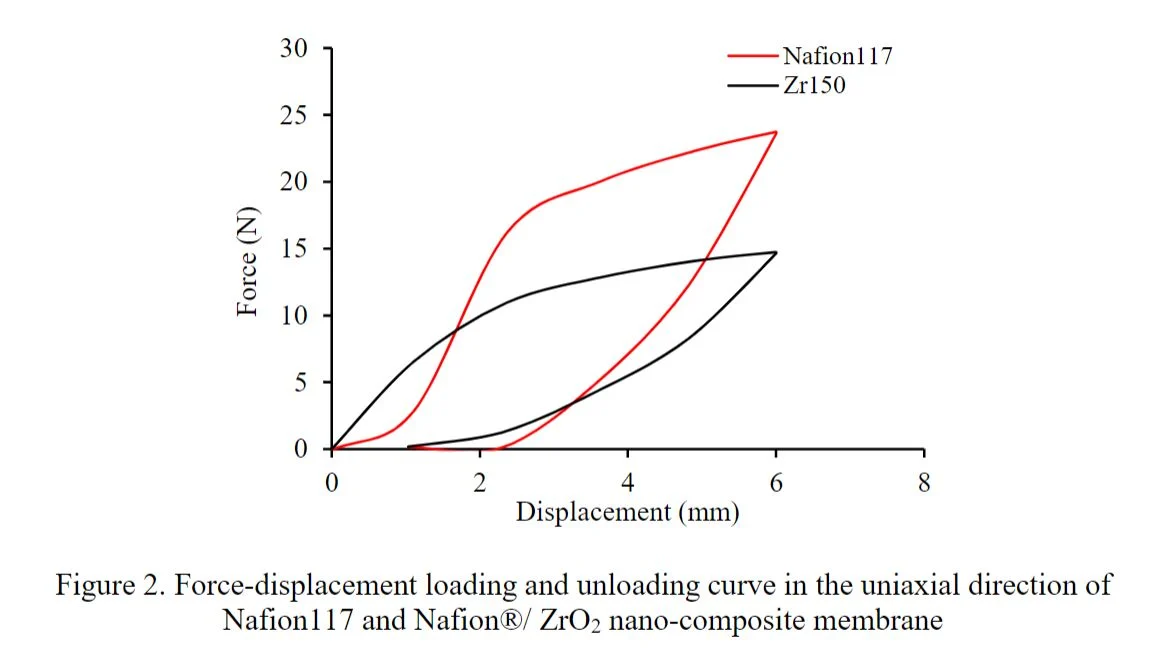
The figure above shows the force and displacement curves of the 2 membranes studied. We can observe that the relative strength of Nafion®117 is higher than the modified version at a given displacement. In future research, the team at University of South Africa will focus on the fatigue properties of Polymer Nafion®.

Read the full journal article here:

http://journal.ump.edu.my/ijame/article/view/339

Read about Dr Nemavhola’s research here. 

To read about bottom-up approaches to bioengineering, click here.

CellScale hexagons, without text

CELLSCALE INSTRUMENT USED

TAGS

Constitutive Modeling, Energy materials, Fuel cell membranes, Hyperelastic material modeling, Mechanical testing of polymers, Polymer mechanics, Tensile Testing, UStretch

POST DETAILS
CATEGORY

Research Highlights

INSTRUMENT USED
UniVert
RESEARCH APPLICATIONS
Polymers and Elastomers Testing
TESTING METHODS
Tensile Testing

Related Posts:

Filter by Category:
Filter by Instrument
Filter by Testing Method:
Filter by Research Application:
UniVert performing hydrated tensile testing on a glowing hydrogel optical fibre mounted between grips in a fluid bath.

July 16, 2026

Hydrogel Optical Fiber Testing Under Repeated Strain

Bioprinted meniscus tissue engineering construct with curved collagen-like alignment patterns in the foreground and a softly blurred CellScale BioTester in the background.

July 2, 2026

Meniscus Tissue Engineering with Boundary-Guided Collagen Alignment

Hydrogel fiber mechanical testing setup showing a thin hydrated fibre suspended across two supports while a small MicroTester beam presses downward in the centre, before and after.

June 25, 2026

Hydrogel Fibre Mechanical Testing of Recombinant Hagfish Protein Materials

MSC spheroids embedded in a translucent PEG-fibrin hydrogel within soft vocal fold-like tissue, with a blurred CellScale MicroTester in the background.

June 11, 2026

Vocal Fold Regeneration with MSC Spheroids

Hydrogel eye drop on a corneal surface with a mechanical testing probe and force-distance curve representing mucoadhesion testing for ocular drug delivery.

May 28, 2026

Mucoadhesion Testing of Hydrogel Eye Drops for Ocular Drug Delivery

May 14, 2026

Flexible Flow Sensor Testing for Pioneering Autonomous Robotics

Contact Sales

Product of Interest:
CellScale hexagon shapes