


Anti-fatigue-fracture Hydrogels

A tensile test divider icon

MIT researchers engineered hydrogels with crystalline reinforcement that dramatically improves fatigue resistance, enabling repeated stretch cycles without fracture in soft biomaterials.

CellScale hexagon shapes

Hydrogels are soft materials that have similar properties to human tissues and could be used for novel medical devices, surgical applications or tissue engineering. However, almost all hydrogels have poor fatigue properties and break upon repeated stretch-relax cycles. This is in sharp contrast to natural tissues (muscle, tendons, etc.), which can withstand millions of cycles per year without rupturing.

In this study, the team at the Zhao Lab at MIT have engineered a new hydrogel that is ten times more fatigue-resistant than existing hydrogels. They have done so by introducing crystalline regions, which are hard nanometer-sized regions made of the same material as the rest of the hydrogel. This creates a reinforced material in the same way that sand is used to reinforce concrete.

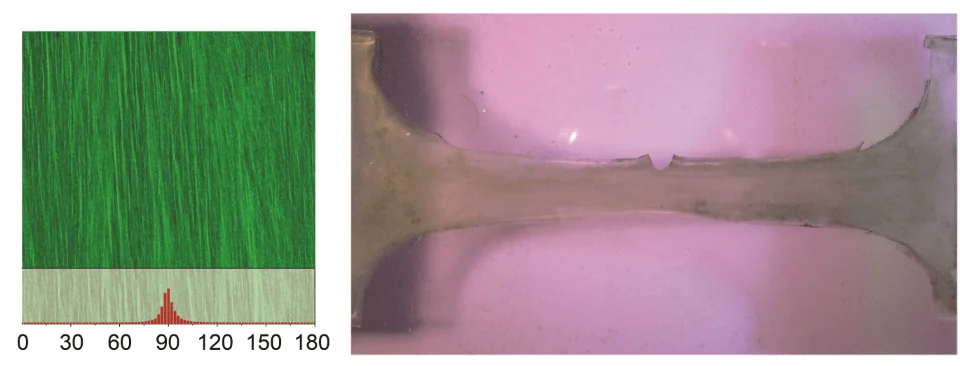
In the images above, the left is a confocal microscopy image of the vertical alignment of crystalline fibres in the hydrogel matrix. This was achieved by stretching the hydrogel with the UniVert. The right image is the dry-annealed hydrogel undergoing a single-notch test with fatigue threshold as high as 1000 J/m2.

Read the full journal article here: http://advances.sciencemag.org/content/5/1/eaau8528

Read about the research from Zhao Lab: http://zhao.mit.edu/our-team/

If you are keen to read another user publication highlight about crystallinity, click here.
CellScale hexagons, without text

CELLSCALE INSTRUMENT USED

UniVert

TAGS

Biomaterials Research, Crystallinity, Fatigue Resistance, Hydrogels, Mechanical Fatigue Testing, Soft Materials, tissue engineering, UniVert

POST DETAILS
CATEGORY

Research Highlights

INSTRUMENT USED
UniVert
RESEARCH APPLICATIONS
Hydrogel Mechanical TestingMaterial Fatigue and Durability
TESTING METHODS
Fatigue TestingTensile Testing

Related Posts:

Filter by Category:
Filter by Instrument
Filter by Testing Method:
Filter by Research Application:
UniVert hydrogel tensile testing setup with camera imaging and a digital image correlation strain map showing localized deformation.

July 30, 2026

Hydrogel Tensile Testing Reveals Strain Localization in Architected Materials

An aortic tissue sample being biaxially tested with BioRakes on the BioTester for vascular tissue engineering research

July 23, 2026

Carotid Artery Biaxial Testing with Axial Pre-Stretch

UniVert performing hydrated tensile testing on a glowing hydrogel optical fibre mounted between grips in a fluid bath.

July 16, 2026

Hydrogel Optical Fiber Testing Under Repeated Strain

Bioprinted meniscus tissue engineering construct with curved collagen-like alignment patterns in the foreground and a softly blurred CellScale BioTester in the background.

July 2, 2026

Meniscus Tissue Engineering with Boundary-Guided Collagen Alignment

Hydrogel fiber mechanical testing setup showing a thin hydrated fibre suspended across two supports while a small MicroTester beam presses downward in the centre, before and after.

June 25, 2026

Hydrogel Fibre Mechanical Testing of Recombinant Hagfish Protein Materials

MSC spheroids embedded in a translucent PEG-fibrin hydrogel within soft vocal fold-like tissue, with a blurred CellScale MicroTester in the background.

June 11, 2026

Vocal Fold Regeneration with MSC Spheroids

Contact Sales

Product of Interest:
CellScale hexagon shapes