Abdominal wall hernia repair often depends on surgical mesh reinforcement, but successful repair is not just about closing the defect. The implanted mesh also needs to behave in a mechanically compatible way with the surrounding abdominal wall. When that compatibility is poor, it can contribute to discomfort, poor load sharing, and recurrence risk.
That is why hyperelastic characterization of hernia mesh matters. This study published in MRS Advances out of the Universidad Michoacana de San Nicolas de Hidalgo in Mexico examined how commercial polypropylene meshes behave under tension and how that behaviour can be modeled more accurately for surgical and computational applications.
CellScale contributed to this work through the use of the UniVert, which the researchers used to perform tensile testing on two commercial hernia meshes. That testing helped show that the materials were not mechanically identical in all directions and that their nonlinear response was better described with a hyperelastic model than with a simple linear assumption.
For broader context on why this type of testing matters in biomaterials research, see our guide to mechanical testing of biomaterials.
Why hyperelastic characterization of hernia mesh matters
Meshes used for abdominal wall repair are expected to reinforce tissue while still accommodating physiological deformation. That means their mechanical behaviour needs to be understood in a way that reflects real loading conditions. The paper emphasizes that biomechanical compatibility between the implant and native tissue is one of the most relevant factors in successful repair, and that understanding the mechanical behaviour of abdominal wall repair materials is essential for improving treatment strategies.
This is also where hyperelastic characterization of hernia mesh becomes especially useful. Surgical meshes do not behave like simple linear elastic materials. Their response is nonlinear, and it can change depending on the direction of loading. For modeling, simulation, and material selection, that kind of detail matters.
What the researchers tested
The team evaluated two commercial polypropylene meshes used in abdominal wall repair: Prolene® and Premilene®. Rectangular specimens were cut from each mesh in two orthogonal directions, described as longitudinal and transverse, so the material could be tested direction by direction. This allowed the researchers to compare not just one mesh against another, but also how each mesh responded when pulled along different orientations.
That directional setup is important because many surgical meshes are structurally anisotropic. In practice, that means the same implant can feel or behave differently depending on how it is oriented relative to tissue loading. For clinicians and researchers, the directional tensile properties of mesh implants are directly relevant to how the material may perform in repair.
How the CellScale UniVert was used
The researchers used the UniVert benchtop mechanical tester to carry out uniaxial tensile tests at room temperature. Force-stretch data were generated for each mesh in both test directions, giving the team a mechanical profile for each material and orientation.
The UniVert was used to measure how the mesh elongated under load and to generate the datasets later used for model fitting. The test images in the paper also show the specimen mounted between clamps and stretched toward failure, which helps make the setup easy to understand for readers who are less familiar with materials testing.

If you want a simpler backgrounder on pulling materials in tension, our post on tensile testing tips and tricks is a helpful related read.
Tensile testing showed anisotropic mesh behaviour
One of the main findings was that the meshes did not behave the same way in every direction. The tensile data showed significant differences between the two commercial meshes, and each mesh also showed anisotropy, meaning its mechanical response changed with the direction of traction. That is a key takeaway for mechanical testing of hernia repair meshes, because it shows that orientation is not a minor detail. It is part of the material behaviour.
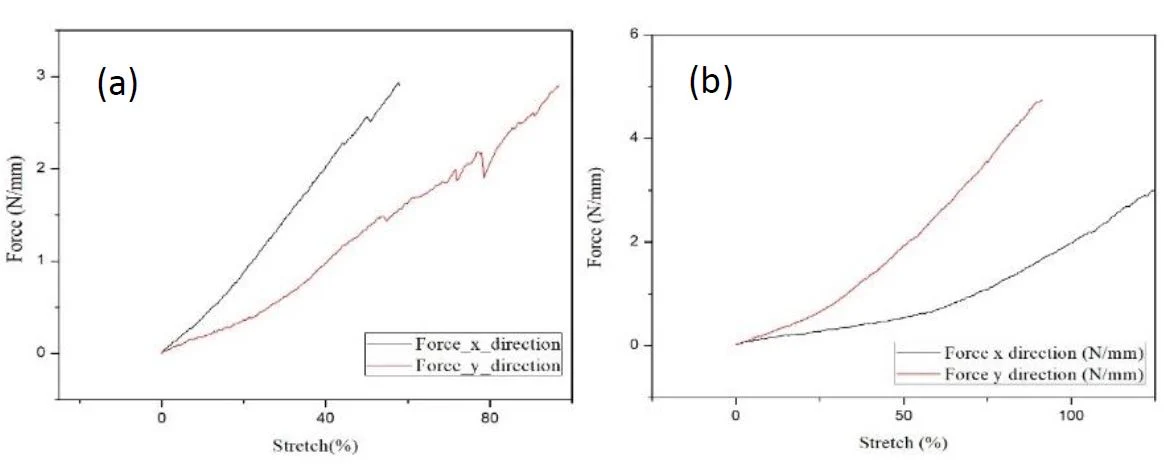
This is exactly why hyperelastic characterization of hernia mesh is more informative than a simple one-number material description. A mesh that is stiffer in one direction than another may interact with the abdominal wall differently depending on how it is placed, which has implications for design, selection, and modeling.
Why a hyperelastic model was used
The authors note that materials used in abdominal wall repair have complex mechanical behaviour that is not faithfully reproduced by traditional linear models such as Hooke’s law. Because of that, they proposed a methodology for generating hyperelastic mechanical models from experimental data to better describe these materials.
Several candidate hyperelastic models were tested, and the five-parameter Mooney-Rivlin model gave the best fit to the tensile data. The fitting was carried out in COMSOL Multiphysics using an optimization approach, allowing the measured force-stretch response to be translated into model parameters for each mesh and direction.
That makes this study especially useful for people interested in hyperelastic modeling of surgical biomaterials. It is not only a testing paper. It is also a bridge from bench-scale tensile data to computational simulation.
Why this matters for finite element modeling and repair design
A good hyperelastic model makes it easier to simulate how a mesh may behave in more realistic geometries and loading environments. The authors conclude that the resulting mechanical model can be used to simulate mesh behaviour with finite element analysis, and that these results are important for developing biomechanical models that reduce poor adaptation between synthetic mesh and host tissue.
That is a meaningful contribution because abdominal wall repair is not a purely materials problem or a purely surgical problem. It sits at the intersection of both. Better mechanical descriptions of mesh implants can support better simulation, better device comparison, and potentially better repair planning.
For a related testing-method perspective, you can also read our post on testing method viscoelasticity, which looks at another way biomaterial behaviour can go beyond simple linear assumptions.
Final thoughts
This study shows why hyperelastic characterization of hernia mesh is useful for abdominal wall repair research. The tested polypropylene meshes displayed nonlinear and direction-dependent behaviour, and the UniVert-generated tensile data supported a five-parameter Mooney-Rivlin description that can be used in finite element modeling.
For researchers working on mechanical testing of hernia repair meshes, that is the main value here: you get a clearer picture of how commercially available meshes behave, how orientation changes that behaviour, and how CellScale tensile testing can provide the data needed for more realistic material models.
Read the publication here: Hyperelastic characterization of synthetic mesh for abdominal wall hernia repair
For more about the instrument used in this study, visit the CellScale UniVert mechanical testing system page.