
Open-Source ACL Injury Model Using Custom 3D-Printed Fixtures



University of Michigan
Department of Orthopaedic Surgery; RE-JOIN Consortium
Project Background
Noninvasive tibial compression–induced anterior cruciate ligament rupture (ACLR) is widely used as an ACL injury model for studying early mechanobiological responses in post-traumatic osteoarthritis. This murine joint loading model provides a controlled way to investigate ACL injury biomechanics following rupture.
Most published approaches rely on biomechanical testing systems that require:
- $100K+ mechanical testers
- Large, immobile frames
- Expert tuning and calibration
- Fixtures that are not openly available
To improve accessibility and standardization across institutions, researchers at the University of Michigan developed the Mobile Joint-Injury Operator (MoJO).
This open-source ACL injury model was designed around:
- A commercially available, low-footprint CellScale UniVert S2 biomechanical testing solution
- A fully 3D-printable fixture set compatible with rodent biomechanics and displacement-controlled testing
Read the full research study here. You can also find the 3D print files and other project resources on GitHub here.

Dr. Tristan Maerz
Assistant Professor of Orthopaedic Surgery and Biomedical Engineering
The Challenge
1. High-speed displacement over a short distance
The ACL rupture event occurs within approximately 1.5 mm of compressive displacement, requiring precise displacement-controlled testing with:
- Rapid acceleration
- Controlled 10 mm/s velocity
- High accuracy of load and displacement measurement
The UniVert S2 met these ACL injury biomechanics requirements, reaching:
- 650 mm/s² acceleration
- 10 mm/s velocity in 14.3 ms
2. Precise hindlimb positioning
Accurate ACL rupture depends on consistent knee flexion angle, tibial alignment, and hindpaw seating within the murine joint loading model. Small positioning deviations produce distinct mechanical signatures during displacement-controlled testing.
3. Reproducibility across operators and institutions
The ACL injury model needed to be deployed consistently across laboratories, allowing rapid setup, straightforward operation by new users, and reproducible results across operators and institutions.
4. Open-source fixtures and low-cost fabrication
All fixture components were required to be fully open-source and fabricated using 3D-printed fixtures. The parts needed to withstand repeated biomechanical loading, assemble using standard hardware, and mount directly to the UniVert S2 without modifying the core instrument. Find the files here.
Custom Mechanical Testing Solution
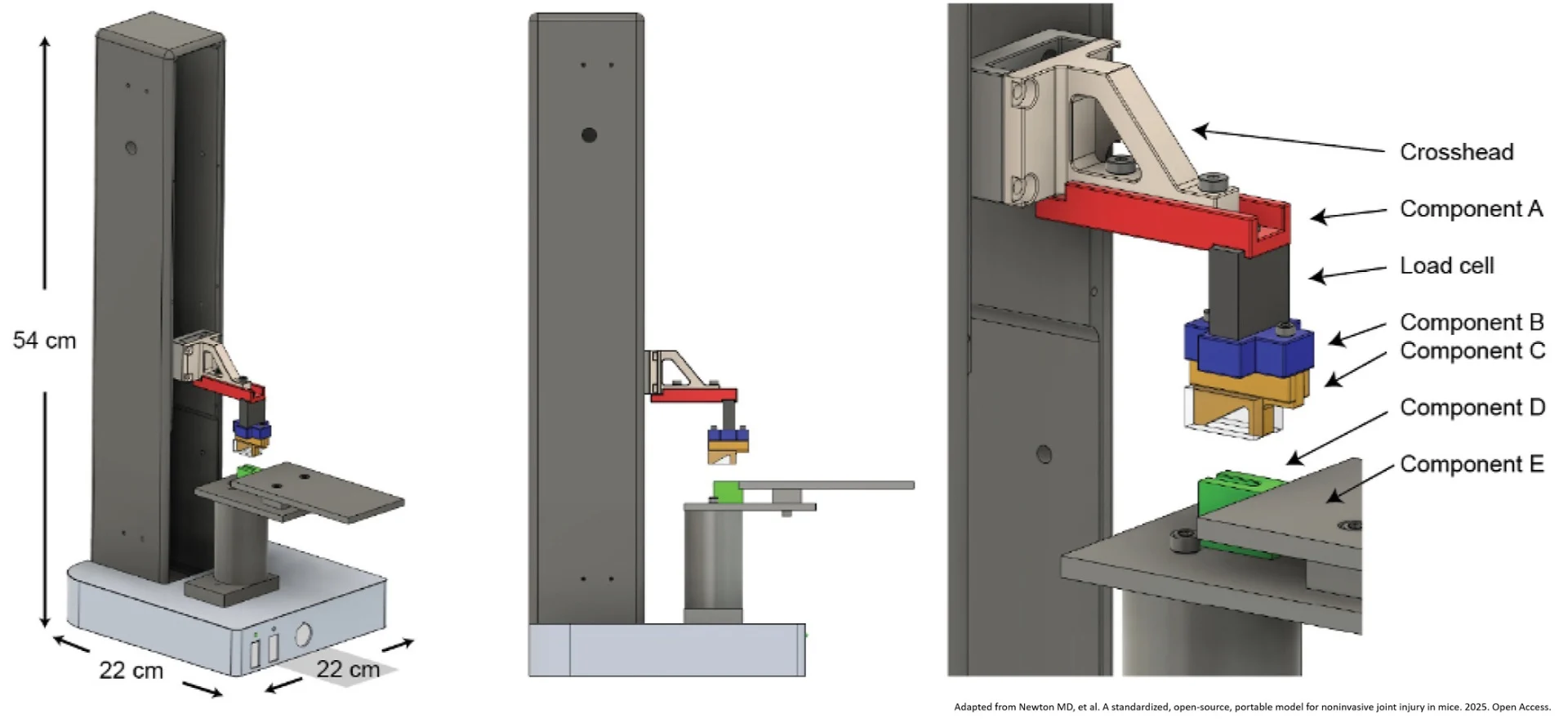
3D-Printed Fixture System Compatible with UniVert S2
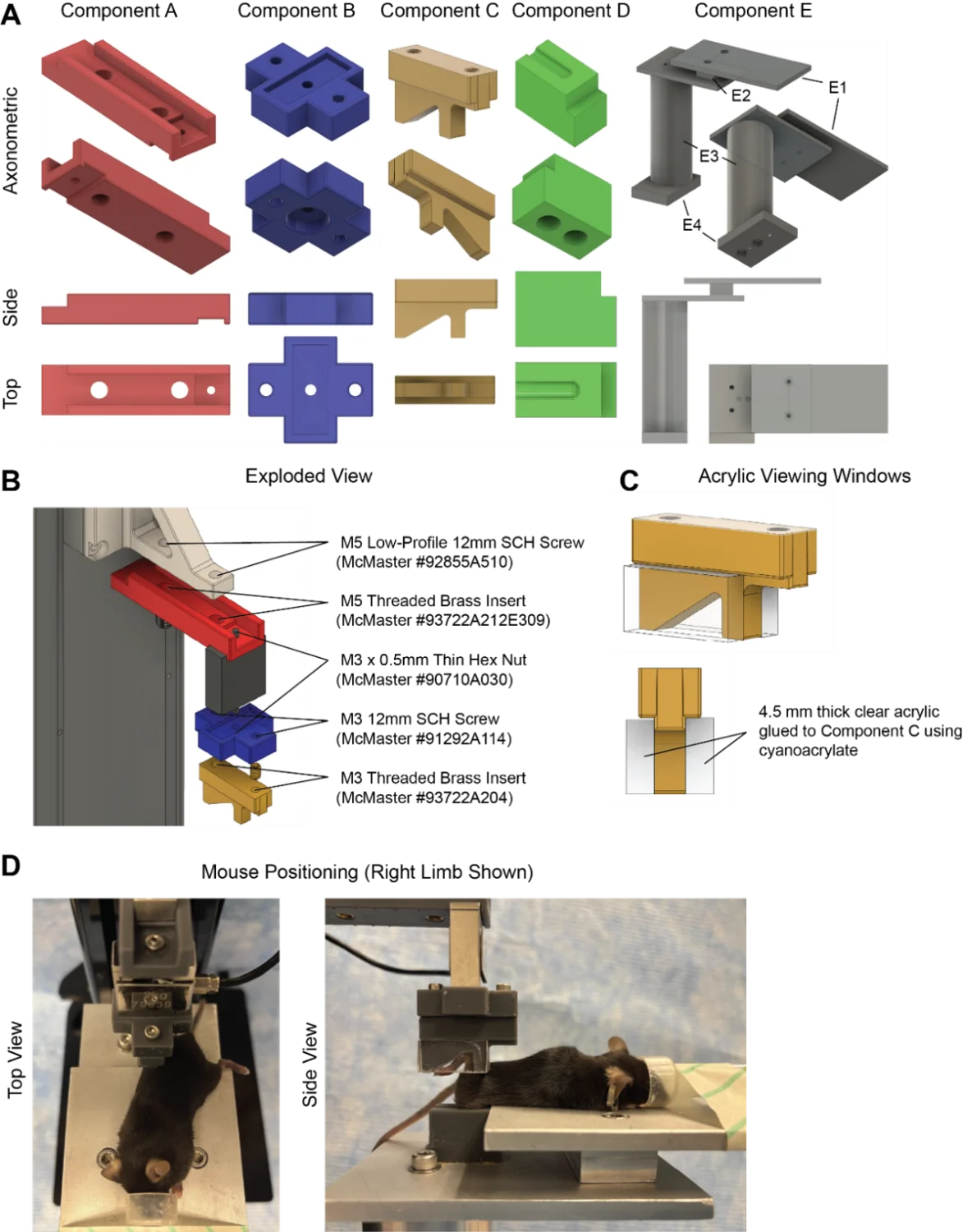
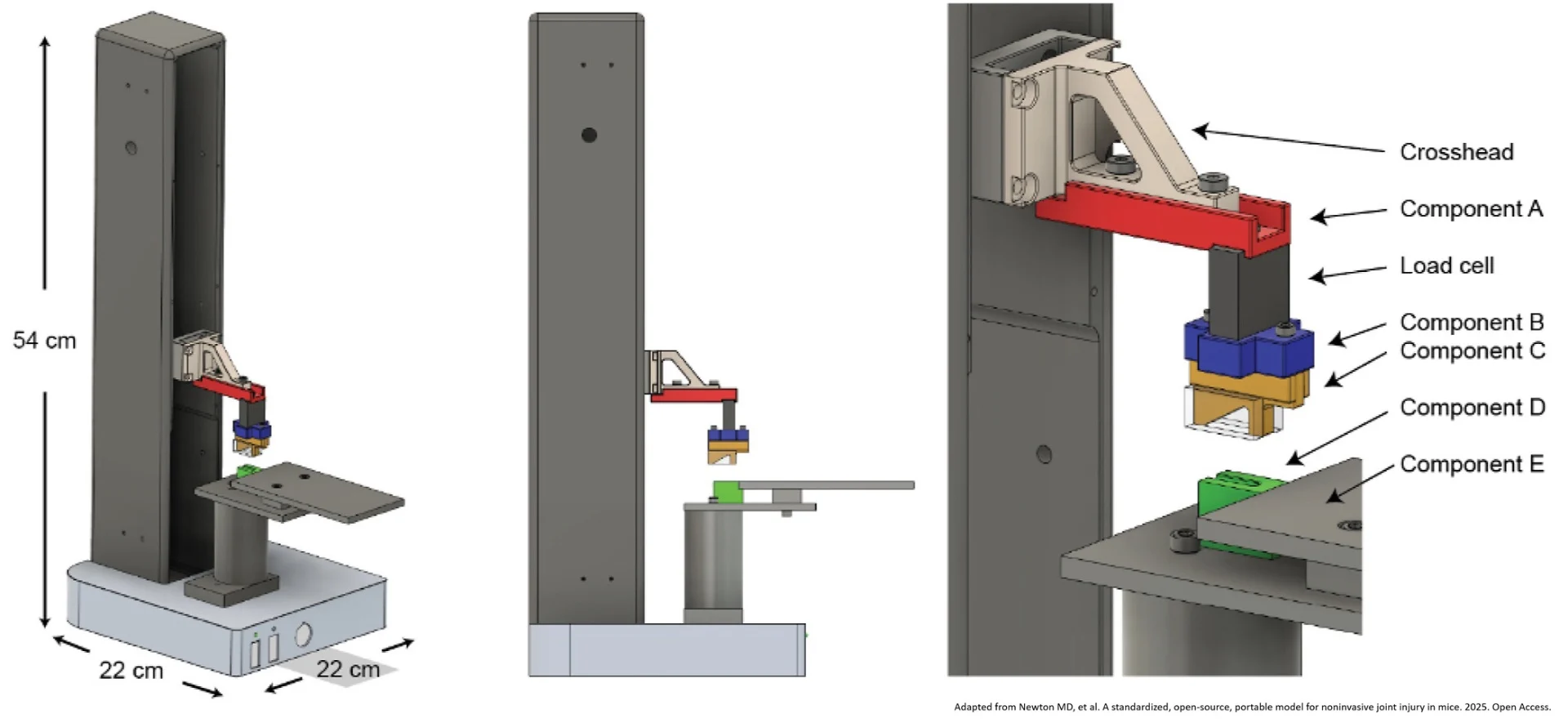
The published MoJO ACL injury model includes a concise set of 3D-printed fixtures designed specifically for displacement-controlled testing on the UniVert S2, including:
- Hindpaw cup with transparent viewing windows
- Knee-positioning trough
- Structural interfaces attaching the fixture assembly to the UniVert load cell and crosshead
- Adjustable animal bed
Together, these components enforce the posture and alignment required for consistent ACL injury biomechanics during murine joint loading.
UniVert S2 Performance for High-Speed Rupture Protocol
As you can read about in the peer-reviewed study, the UniVert S2 combined with the 3D-printed fixtures achieved:
- Crosshead acceleration: 650 mm/s²
- Crosshead deceleration: 604.5 mm/s²
- Target speed: 10 mm/s
- Time to accelerate to target speed: 14.3 ms
- Optimal tuning settings: velocity 9, acceleration 9
These parameters allowed the UniVert-based biomechanical testing solution to replicate the kinematic requirements of traditional servo-hydraulic ACL injury systems using displacement-controlled testing.
ACL Injury Protocol
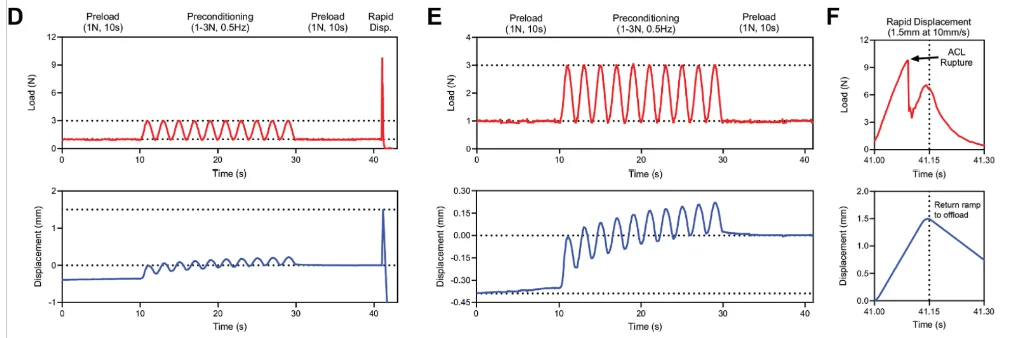
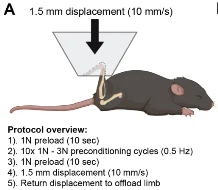
The full five-step displacement-controlled ACL injury protocol consisted of:
- 1 N preload (10 s)
- Ten preconditioning cycles between 1–3 N at 0.5 Hz
- 1 N preload (10 s)
- 1.5 mm displacement at 10 mm/s
- 5 mm return displacement at 5 mm/s
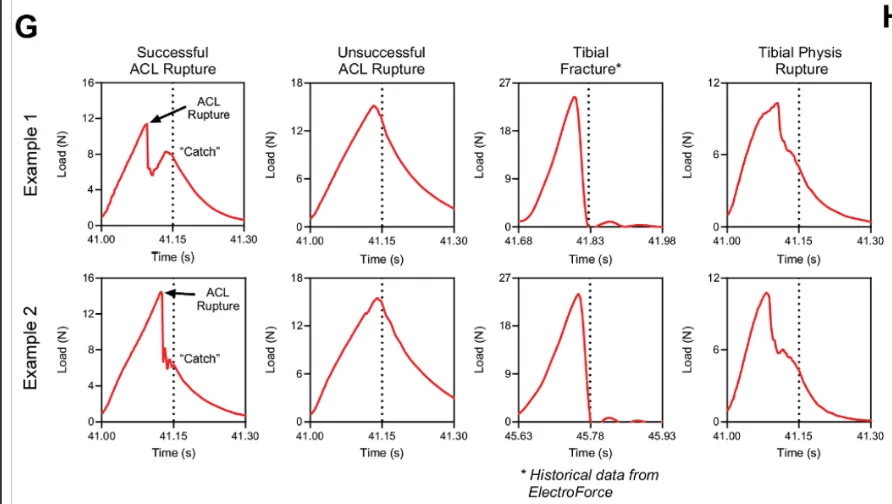
This loading sequence produces the characteristic ACL rupture signature shown in Fig. 1G in the paper.
Research Outcomes and Validation
1. High repeatability across 952 procedures
Across 952 ACL rupture attempts using this ACL injury model, the MoJO system achieved a 99.0% success rate, with only 10 unsuccessful outcomes (7 non-ruptures and 3 physeal injuries).
2. Reproducibility across operators and institutions
Data collected across four operators (n = 955 procedures) showed differences in failure load and stiffness below 3%. Small variations were associated with differences in limb positioning. Additional testing across collaborating laboratories (n = 43 procedures) produced comparable mechanical results using the same murine joint loading protocol.
3. Equivalent performance to a high-end ElectroForce system
Paired bilateral testing (n = 9 mice) demonstrated no differences in failure load or displacement between the MoJO ACL injury model and a commercial ElectroForce system. Mechanical outcomes and downstream biological measures, including flow cytometry and knee hyperalgesia, were comparable.
4. Expected PTOA phenotype reproduced
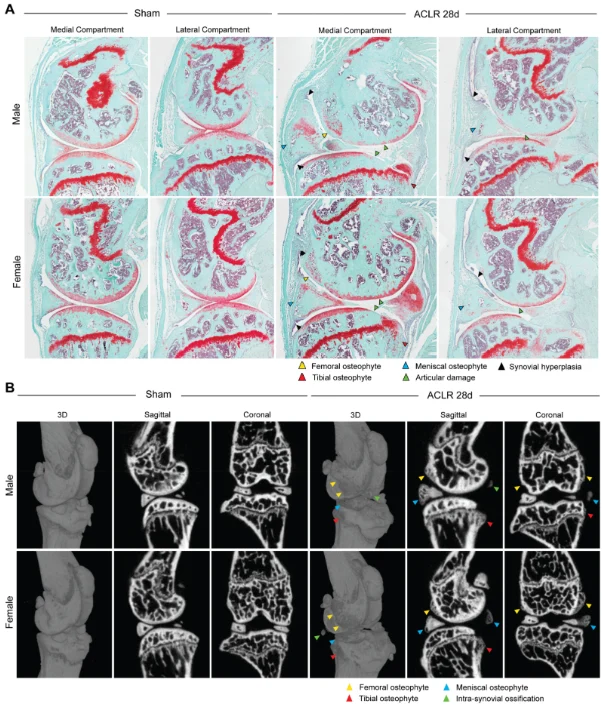
µCT imaging and Safranin-O/Fast Green histology showed osteophyte formation, cartilage erosion, synovial hyperplasia, and changes in stromal and immune cell populations. Similar structural features have been reported in post-traumatic osteoarthritis models using established ACL injury approaches.
Key Engineering Features
Open-source ACL injury model designed around UniVert geometry, with shared CAD files, MATLAB analysis scripts, and protocol documentation
3D-printed, rigid fixture assembly for standardized murine joint loading with minimal fixture deformation
Unified fixture alignment to guide force transmission through the ACL during biomechanical testing
Load-controlled preconditioning followed by high-speed displacement-controlled rupture testing
Portable UniVert-compatible testing setup with a compact instrument footprint of 8 kg and 22 × 22 × 54 cm
Related Publication
TITLE
A Multimaterial Microphysiological Platform Enabled by Rapid Casting of Elastic Microwires
JOURNAL
Osteoarthritis and Cartilage Open
APPLICATIONS
RESEARCH SUMMARY
MoJO (Mobile Joint-Injury Operator) is an open-source ACL injury model designed for portable, standardized murine joint loading. Using displacement-controlled testing on a CellScale UniVert S2 combined with 3D-printed fixtures, the system achieved a 99% success rate across more than 950 ACL ruptures. Mechanical outcomes and downstream PTOA phenotypes were reproducible and comparable to results obtained using high-end servo-hydraulic systems, supporting its use as an accessible biomechanical testing solution for preclinical osteoarthritis research.
Citation: Newton M.D., Lammlin L., Gonzalez-Nolde S., et al. A standardized, open-source, portable model for noninvasive joint injury in mice.
Osteoarthritis and Cartilage Open 7 (2025): 100679. DOI: 10.1016/j.ocarto.2025.100679
Interested in Custom Fixtures or Adaptations?
CellScale works with research groups on custom 3D-printed fixtures, high-speed and displacement-controlled testing protocols, and adaptations for different sample geometries. These projects involve benchtop biomechanical testing setups for ACL injury biomechanics and related studies.