Active Lung Pressure Volume Testing for Lung Research


University of California, Riverside
Eskandari Lab – Pulmonary Mechanics and Soft Tissue Biomechanics
Project Background
Pulmonary diseases such as asthma, emphysema, and COVID-19 alter lung structure and dramatically change pressure–volume lung mechanics. Traditional pressure-controlled systems and lung biomechanics devices provide limited reproducibility, require degassing of the lung, and cannot capture whole-organ viscoelastic responses.
Professor Mona Eskandari’s team at UC Riverside needed a system that could:
- Accurately measure pressure–volume curves under volume-controlled loading
- Quantify viscoelastic relaxation, hysteresis, compliance, and strain-dependent mechanics
- Compare positive-pressure ventilation (PPV) with more physiological negative-pressure ventilation (NPV)
- Accommodate both murine and porcine lungs
- Integrate with digital image correlation (DIC) for high-resolution strain mapping
CellScale collaborated to design and manufacture a custom dual-scale lung pressure volume testing machine meeting these experimental challenges.

Dr. Mona Eskandari
University of California, Riverside


The Challenge
Accurate Pressure–Volume Measurement
Existing systems were pressure-controlled and unable to produce standardized, repeatable PV curves. Degassing steps were required, which altered tissue mechanics and prevented repeated testing.
Capturing Viscoelastic Lung Behaviour
The team needed real-time measurement of relaxation, rate dependence, and hysteresis (behaviours central to disease progression).
Dual-Scale Requirements
The lung pressure volume testing system needed to work for:
- Mouse lungs with volumes in the milliliter range
- Pig lungs with volumes in the liter range and high airflow demands
PPV vs. NPV Ventilation Comparison
No existing lung biomechanics device allowed controlled, reproducible comparisons between artificial ventilator-type loading and physiological breathing mechanics.
Custom Solution Developed by CellScale
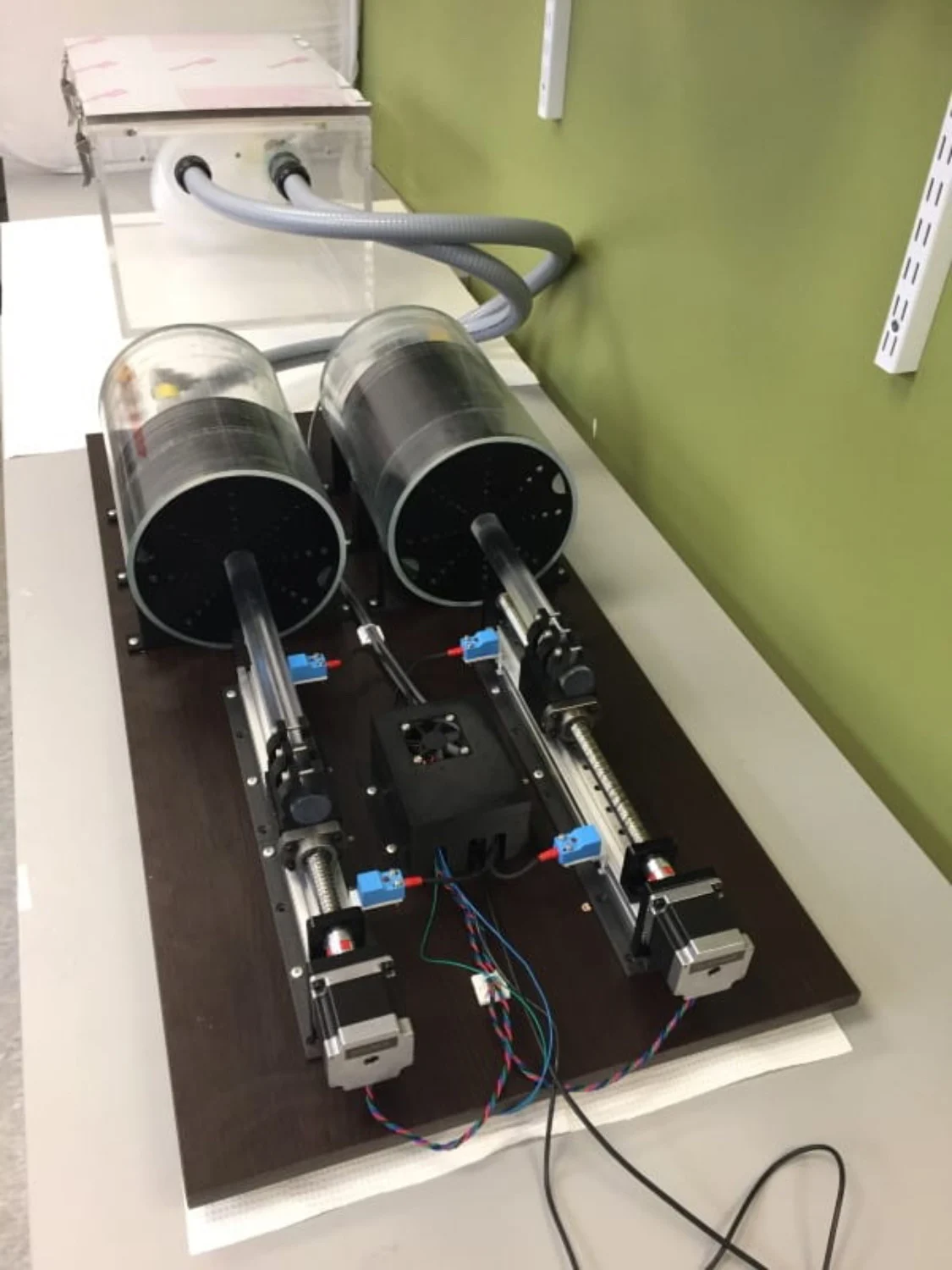
Dual-Piston Lung Pressure Volume Testing Ventilation System
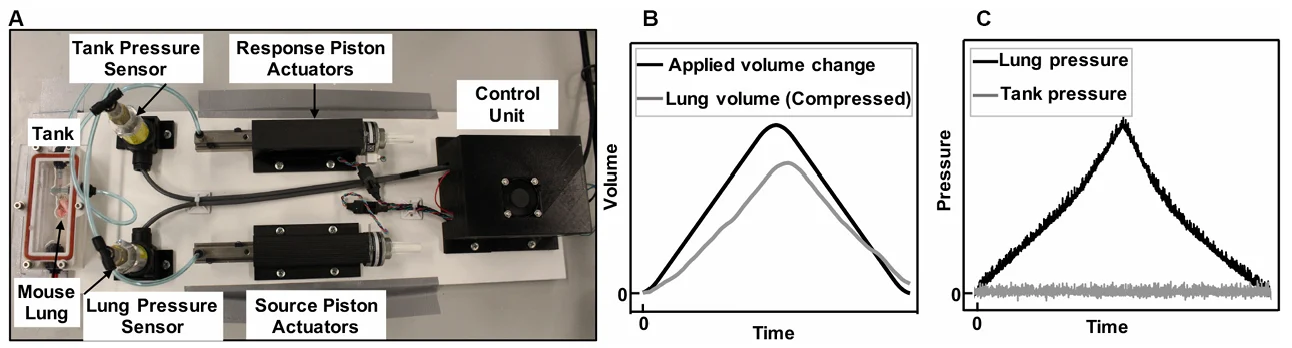
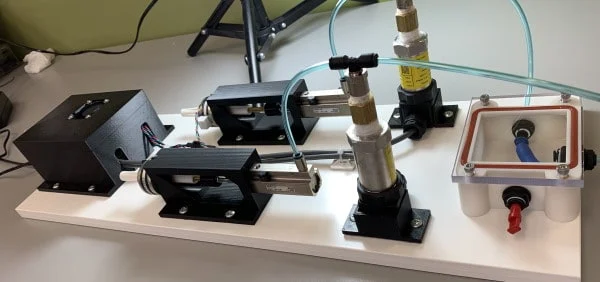
CellScale engineers collaborated with the research team to build a custom volume-controlled, pressure-monitored lung testing system, consisting of:
- Two precision actuators (source and response pistons) enabling volume-driven loading and real-time pressure equalization
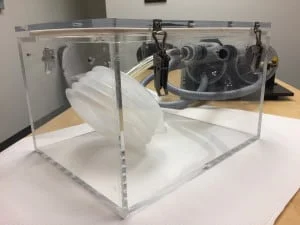
- Transparent sealed tank, compatible with submerged testing and digital image correlation-based strain mapping
- Interchangeable small and large tanks for mouse and pig lungs
- Closed-loop PID control to maintain atmospheric tank pressure during lung expansion
- Real-time gas compressibility correction based on piston displacement
These design elements produced continuous, reproducible PV curves without lung degassing, a major improvement in whole organ mechanical testing, specifically for pulmonary viscoelasticity testing.
Positive- and Negative-Pressure Ventilation Modes
The unique piston configuration allowed the system to switch between:
- Positive-pressure ventilation (PPV): air pushed into the lung
- Negative-pressure ventilation (NPV): the tank volume increases, pulling the lung open
This innovation enabled the first direct side-by-side mechanical comparison of PPV and NPV on the same specimen.
Results and Scientific Impact
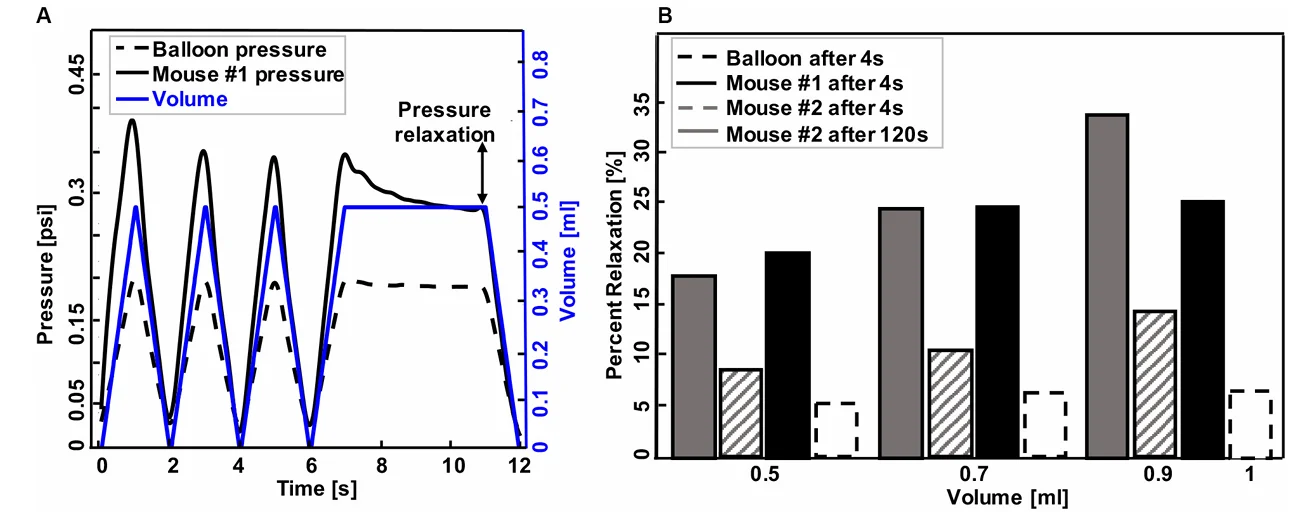
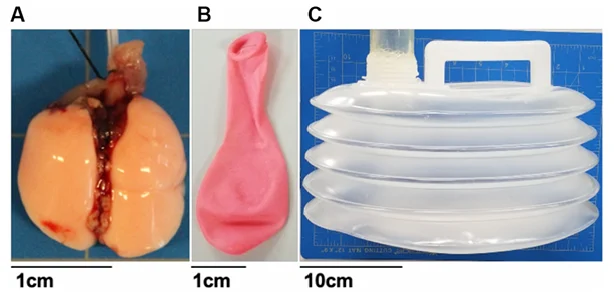
Figures adapted from Front. Bioeng. Biotechnol. 20 October 2020 Sec. Biomechanics Volume 8 – 2020 | https://doi.org/10.3389/fbioe.2020.578762
Validated Against Literature
PV curves from the new system matched expected pressure–volume lung mechanics behaviour and showed excellent agreement with published data under varied conditions.
High Sensitivity to Viscoelastic Properties
The system captured:
- Hysteresis
- Stress relaxation
- Rate-dependent compliance
- Strain-dependent nonlinearities
These features are central to lung disease modeling.
First-of-Its-Kind PPV vs. NPV Comparison
The study demonstrated that identical volume changes lead to distinctly different pressure and strain behaviours under the two ventilation modes. This information is particularly relevant for ventilator-induced lung injury (VILI) research and has been cited in over 20 other peer-reviewed publications.
Multi-Scale Applicability
This lung pressure volume testing platform successfully tested:
- Mouse lungs
- Porcine lungs
- Elastic balloons for validation
- Accordion bladders for ventilation-mode simulations
Key Capabilities Enabled
Dual-scale testing (mouse and pig lungs)
Real-time gas compressibility correction
Continuous volume-controlled loading for whole organ mechanical testing
Viscoelastic and temporal mechanics measurement
Transparent chamber for imaging and DIC strain mapping

Related Publication
TITLE
Introducing a Custom-Designed Volume-Pressure Machine for Novel Measurements of Whole Lung Organ Viscoelasticity and Direct Comparisons Between Positive- and Negative-Pressure Ventilation
JOURNAL
Frontiers in Bioengineering and Biotechnology
APPLICATIONS
RESEARCH SUMMARY
This study introduces a custom, novel, automated lung pressure volume testing device for characterizing the viscoelastic macromechanics of whole lungs and enabling direct comparison between positive-pressure ventilation (PPV) and negative-pressure ventilation (NPV). Unlike traditional pressure-controlled systems, the novel lung biomechanics device generates standardized, continuous volume–pressure curves without requiring lung degassing, while accounting for air compressibility in real time. Validation using ex vivo murine lungs, elastic balloons, and water bladders demonstrated accurate capture of compliance, hysteresis, preconditioning, and pressure-relaxation behaviour. The system revealed clear dependencies of pressure–volume lung mechanics on inflation volume and rate and enabled the first direct experimental comparison between PPV and physiologically relevant NPV mechanics. The platform expands experimental capabilities for pulmonary viscoelasticity testing and provides a foundation for improving ventilator strategies and whole organ mechanical testing.
Citation: Sattari S., Mariano C.A., Vittalbabu S. et al. Introducing a Custom-Designed Volume–Pressure Machine for Novel Measurements of Whole Lung Organ Viscoelasticity and Direct Comparisons Between Positive- and Negative-Pressure Ventilation. Frontiers in Bioengineering and Biotechnology, 2020. https://doi.org/10.3389/fbioe.2020.578762
Interested in a Similar Custom Solution?
CellScale engineers have built custom platforms for organ-level tissue mechanics, airway and respiratory research, physiological loading environments, and pressure, volume, and flow-controlled systems.